Guides
Starting a farmers market vendor business: the decisions you cannot undo
Starting a farmers market vendor business turns on stall fees, permits, product rules and market-day cash. These are the choices you cannot undo.
What to take away
- Your county health department, your state cottage food office and your market manager each set rules for a farmers market vendor business, and they set them differently from the next county over.
- A canopy, tables, weights and a certified scale are one-time buys.
- Labels, a card reader and a liability certificate also come before the first sale.
- Cottage food statutes decide whether you sell from a home kitchen or rent a commercial one.
- Pre-orders cover a bad weather day; walk-up sales do not.
- Break-even per market day is a number you can work out before you apply.
- Break-even units per day are booth fee plus mileage plus spoilage, divided by gross margin per unit.
- Cold chain, display and the morning routine decide what you can actually load, chill and set up alone.
- Scales, labels and price signs are inspected. Confirm the rules with your state weights and measures office and the market manager.
- SNAP, WIC and FMNP token handling is arranged market by market. Ask the manager before the first Saturday.
- Keep one folderpermits, insurance certificate, kitchen records, weekly cash sheet.
The decisions you cannot undo
A market season is short, and applications close before it opens. Pick a product line, a market and a stall size, and you have committed your tent, your labels, your permits and your Saturdays.
Most of those choices can be changed next season. Very few can be changed mid-season, which is why they are worth an afternoon of arithmetic now.
Pick the product before the market
Cottage food laws decide what you can make in a home kitchen. States publish an allowed list, usually baked goods that keep at room temperature, jams and jellies, candy and honey. Each state also sets its own label rules and its own annual sales cap.
California registers Cottage Food Operations through county environmental health and splits them into Class A, direct sales only, and Class B, direct plus sales through shops. Texas lists its cottage food rules through the Department of State Health Services. Confirm your state's current version with the cottage food office before you print a label.
Anything with meat, dairy or a low-acid canned process usually pushes you into a commercial kitchen. That changes your rent, your schedule and your margin, so it is the first fork in the road.
Choose the market, not just the town
Two markets ten miles apart can carry different fees, hours and shoppers. Apply to the one whose regulars already buy what you make.
The USDA Local Food Directories lists markets by state and is built from information market managers submit. Use it to build a shortlist, then confirm eligibility, application dates, product rules and insurance limits with each manager directly. The directory is a starting point, not the rulebook.
Big city markets are harder to enter. The Ferry Plaza Farmers Market in San Francisco, run by CUESA, and the Union Square Greenmarket in New York, run by GrowNYC, both review vendor applications and limit how many sellers share a product category. Small town markets often have open stalls and a one-page form.
Applications for a spring opening typically close in January or February, and large markets often jury vendors the previous fall. Day stall fees commonly run $15 to $40 at small markets and $50 or more in big cities.
What the stall actually costs
| Item | When you pay | Note |
|---|---|---|
| Stall fee | Weekly or seasonal | Set by the market, ask the manager; typically $15 to $40 a day at small markets and $50 or more in big cities |
| Tent, weights, tables | Once | A 10x10 canopy runs $100 to $250, four 40 lb weights $40 to $120, folding tables $40 to $90 each; weights matter on a windy day |
| Scale | Once | A legal-for-trade scale typically costs $150 to $400; check your state weights-and-measures rules |
| Labels | Per batch | Content rules come from your state; small print runs cost about $0.10 to $0.50 a label |
| POS and card reader | Once, plus fees | Square Reader is $49 and its published in-person rate is 2.6% plus 10 cents; other processors price differently |
| Liability insurance | Annually | Typically $250 to $700 a year for a small vendor; some markets require a certificate |
| Health and business permits | Once or annually | A city business license typically runs $50 to $200; a county temporary food permit varies |
| Mileage, ice, spoilage | Weekly | Track mileage at the IRS standard rate, 70 cents a mile for 2025, or it disappears |
Write the seasonal total in your own figures. Setup gear plus permits usually lands between $1,000 and $3,000, and recurring costs add $50 to $150 a market day before ingredients. The stall fee is published by the market; everything else you price yourself.
Break-even units per market day are booth fee plus mileage plus spoilage, divided by gross margin per unit. Put your own figures in it. If break-even lands above what you can harvest, pack and sell in one morning, the stall is too big or the market is wrong.
Four weeks out, run one worked example. Use the market's day fee, mileage at the IRS standard rate of 70 cents a mile for 2025, and your spoilage estimate. A $25 day fee, mileage of $21 for a 30 mile round trip and $20 of spoilage come to $66 a day before ingredients.
At a $4 gross margin per unit, break-even is 17 units.
Cold chain, display and the morning you actually have
Perishables set the schedule. Coolers, ice, shade and a thermometer decide how long a display can stand in July. Your local health department is the authority on holding temperatures for your product.
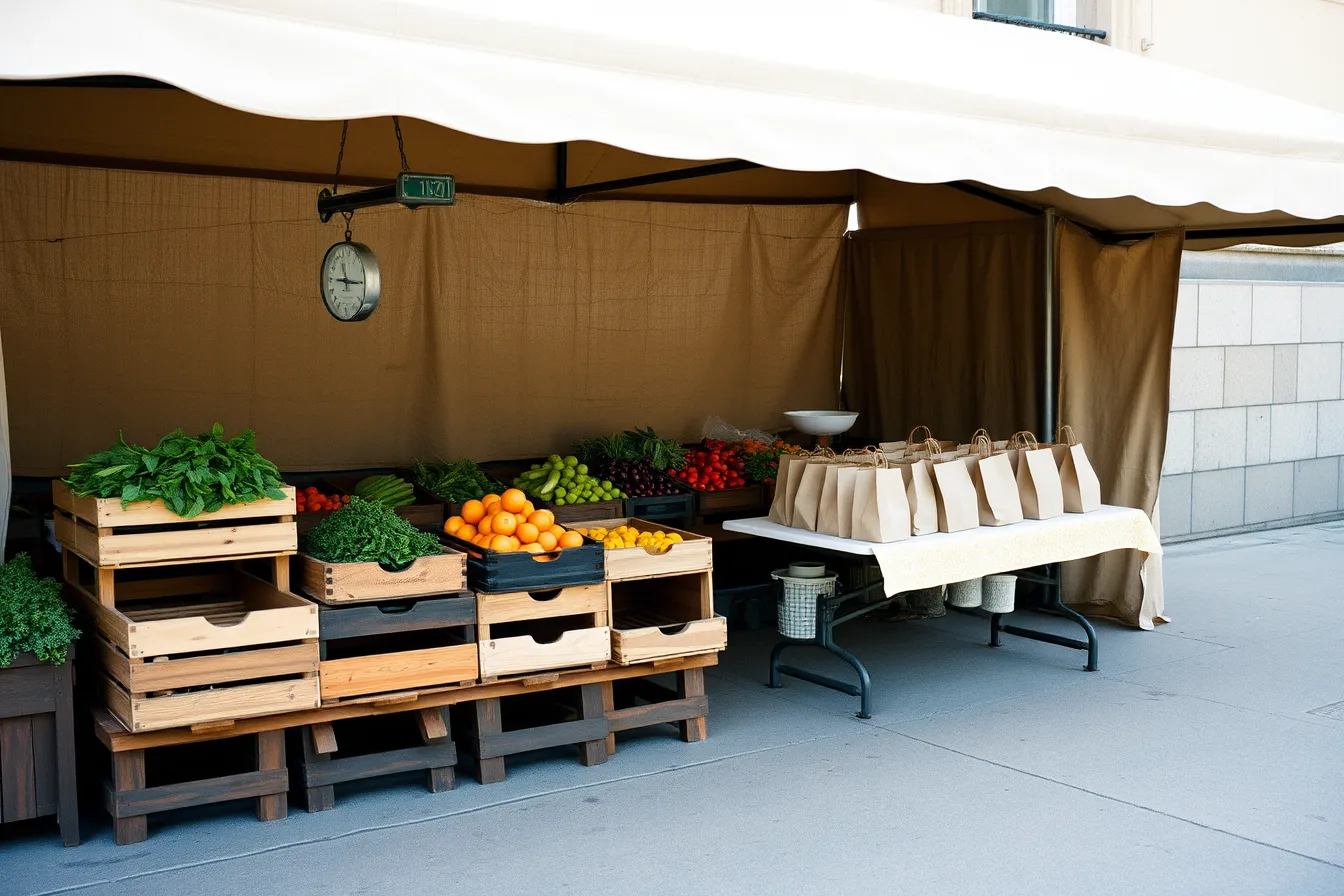
Build the booth so one person can run it. A tent, two tables, a scale, a cash box and a card reader are a load one vendor can set up alone. Add a second seller when the queue, not the setup, is the bottleneck.
Three display habits hold up:
- Price every item. Unpriced goods slow the line and invite haggling.
- Face labels outward so a customer reads them without lifting the jar.
- Keep a written sell-through count per item each market day. Two seasons of counts tell you what to plant.
Overstocking perishables is the most common first-season loss. Pack to your best sell-through day, not your best-ever day.
Set a price that carries a bad day
Price to cover a rained-out Saturday, because you will have one. If a market day costs you $120 in fees, travel and spoilage, and you sell 40 units that day, your floor is $3 a unit before ingredients.
Start at three times ingredient cost, then check the result against that floor. Anything below it is a hobby you are funding. Above it, you have a business that can survive a wet weekend.
Work the permit layers in order
Start with the market manager, who will tell you what the market requires. Then the county or city health department, which licenses food handling and inspects. Then your state, for cottage food registration or a food processing license. Then the IRS, for your business structure and tax ID.
Two permits sit outside those four. Your state revenue department issues a sales tax permit, and your city or county issues a business license. A scale used for selling needs a seal from your county weights and measures office.
Scales, labels and price signs are inspected. Confirm the current rules with your state weights and measures office and the market manager.
SNAP, WIC and FMNP token handling is arranged market by market. Some markets issue tokens centrally and reimburse vendors. Others require you to be authorized and equipped. Ask the manager what the market uses and what you must sign before your first Saturday.
The SBA business guide walks through permits, insurance and startup costs in general terms. The IRS starting a business page covers structure, tax ID and recordkeeping. Neither replaces a call to your own health department.
Food handling rules are not something this article can teach. Take a certified food handler course such as ServSafe, which lists an online food handler course at about $15, and follow your inspector's guidance. Many states also want one ServSafe Food Protection Manager on site, and that course and exam typically cost $150 to $200.
Pre-orders and the weather
A pre-order list turns a rained-out market into a pickup run. It also tells you what to harvest or bake before you commit the batch.
Collect orders three to five days out through a Google Form, a Square invoice or a text list. Set a pickup window of 30 to 60 minutes, and state how long you will hold an unclaimed order. A prepaid season share, paid in winter, covers seed and supplies before the market opens.
That habit protects perishable stock that would otherwise ride home in the cooler.
Keep the books weekly
A market day generates a pile of small transactions. Reconcile them the same week, or the season ends and you cannot tell which product paid.
Track four numbers: sell-through by item, margin by item, break-even per market day, and cash on hand. Wave is a free accounting app, and Square Dashboard reports sales by item if you sell through Square. The farmers market vendor business plan lays out where each belongs in the written plan.
Set aside self-employment tax as you go. It runs 15.3% of net profit, on top of income tax, and the IRS takes quarterly estimated payments.
One folder holds permits, insurance certificate, kitchen records and the weekly cash sheet. It answers most questions a market or an inspector will ask.
Common questions
Do I need a license to sell at a farmers market?
Almost always, and more than one. The market manager sets vendor rules, the local health department licenses food handling, and your state sets cottage food or processing requirements. A city business license, a state sales tax permit and a liability certificate are common extras. Confirm each with the office that issues it, because they vary by product and jurisdiction.
Can I sell from my home kitchen?
Only if your state's cottage food law covers your product and you follow its labeling and sales limits. Meat, dairy and low-acid canned goods usually fall outside it. California's Class A and Class B Cottage Food Operations and the Texas cottage food rules are two published versions to read. Your state cottage food office keeps the current list.
How do I price for a market season?
Add your seasonal costs, divide by the units you expect to sell, and treat that as your floor. The stall fee comes from the market; the rest you estimate and revise as the season goes. A CPA can check the method.
What if a market day gets rained out?
You lose the walk-up sales, not the pre-orders. Build a pre-order list and a pickup window so a wet Saturday still moves product. Price the season so one bad day does not sink it.