Guides
How US cottage food laws decide what you can sell from a home kitchen
Farmers market vendors selling homemade food face a patchwork of state cottage food law rules that decide allowed products and labeling for home kitchens.
What to take away
- For farmers market vendors, cottage food law is state law, not federal law, so the allowed products list and labeling rules change the moment you cross a state line.
- The California Homemade Food Act and the Texas Cottage Food Law are the two most copied models, and both cap sales and ban certain foods outright.
- County health department permits, not state registration, are usually the first thing a home kitchen food business has to obtain.
- Every state covered here requires a label with the producer's name, address, product name and a cottage food statement.
- Selling online, wholesale or across state lines pushes you out of cottage food rules and into commercial kitchen rules.
How the FDA Food Code flows down into state cottage food laws
The FDA Food Code serves as a model rather than a law. It is written by the Food and Drug Administration and offered to states, territories and tribes as a recommended framework for retail food safety. No state is obligated to adopt it, and none adopts it word for word.
The FDA Food Code | FDA sets the baseline that state cottage food laws then modify. Where a cottage food law is silent, inspectors and courts often fall back on the adopted Food Code version in that state.
The 2022 edition covers temperature control, bare hand contact, date marking, cooling and reheating, and employee health. Those are exactly the provisions a cottage food exemption tends to relax. The Food Code 2022 | FDA is the version most states have been moving toward, though adoption lags by years.
A cottage food law is a narrow carve-out. It says a private home kitchen does not have to meet retail food establishment standards for a defined list of low-risk foods. Step outside the list and the full Food Code applies again.
Low risk is the organizing idea. Rules assume pathogens need moisture and protein to grow, so dry, acidic and shelf-stable goods get the exemption. Anything requiring refrigeration generally does not.
State departments of agriculture and state health departments split this work. In Texas the Department of Agriculture publishes cottage food guidance. In New York the Department of Agriculture and Markets and the Health Department both touch it.
Federal rule changes that affect food sellers show up in the Federal Register, and the Federal Register :: Health & Public Welfare topic is the place to watch for proposed and final rules. Cottage food law itself rarely appears there, because it is state-level.
Three practical consequences follow. First, there is no national cottage food license. Second, a product legal at home may be illegal at a market two states away. Third, the burden of knowing your state's list sits on you, not on the market manager.
If you are still deciding whether the business is worth the paperwork, the rules a farmers market vendor clears before opening are a useful starting inventory of what regulators will ask for.
California Homemade Food Act: the allowed foods list and labeling rules
The California Homemade Food Act, signed in 2012 and commonly called the Cottage Food Operation law, created two registration tiers. Class A operations sell directly to consumers. Class B operations may also sell indirectly through a retail store or restaurant.
California Cottage Food Tiers
Class A
- Sales
- Direct only
- County
- Registration
- Food handler card
- Required
- Home kitchen inspection
- No
Class B
- Sales
- Direct and indirect
- County
- Permit and inspection
- Food handler card
- Required
- Home kitchen inspection
- Yes
Class A registers with the county health department and pays a fee. Class B requires a permit and an inspection of the home kitchen. Both tiers require a food handler card for the operator.
California's allowed products list is built around shelf-stable goods. Baked goods without cream or custard fillings lead it, along with jams and jellies, fruit butters, candy and chocolate-covered items. The list also covers dried fruit, granola and similar dry mixes, honey, and roasted coffee beans.
Some items carry extra conditions. Jams and jellies must meet the pH and processing standards in the law. Fermented foods and kombucha are not on the standard list. Refrigerated cheesecakes, custard pies and anything with a cream filling are out.
Sales are capped. California sets an annual gross sales ceiling for cottage food operations, and the figure is adjusted over time, so check the current number with your county rather than relying on an old blog post.
Labeling is specific. A California cottage food label must carry the product name and the name and address of the operation. It must also show the permit or registration number, the ingredients in descending order by weight, the net weight or count, and the phrase "Made in a Home Kitchen."
Allergen disclosure follows federal labeling law. If the product contains a major allergen, the label must say so. That covers milk, eggs, fish, shellfish and tree nuts. Peanuts, wheat, soybeans and sesame are on the same list.
Direct sales include sales from your home, at a certified farmers market, at a community event, and by phone or online to a California consumer. Indirect sales are what separate Class B from Class A.
California also runs a cottage food training requirement, and many counties point operators to a state-approved course. Keep the certificate. Inspectors ask for it.
One trap: the home kitchen must be a private residence, and it cannot be used for a commercial food business under another permit. Running two food operations from one kitchen creates a conflict.
Texas Cottage Food Law: what a home kitchen can sell and where
The Texas Cottage Food Law is Texas Health and Safety Code Chapter 437, and the Texas Department of Agriculture publishes the guidance and the required training. Texas does not require a permit or license for a cottage food operation, and it does not inspect home kitchens.
That is the trade. No permit, no inspection, but a hard limit on what you may make and where you may sell it.
Texas allows a defined list of time and temperature stable foods. Baked goods, candy, coated and uncoated nuts, fruit jams and jellies, and fruit butters are all on it. So are dried fruit, dry herb and spice mixes, vinegars, popcorn and pickled vegetables.
Pickled vegetables are allowed only if they meet the acidity requirement in the law. Canned vegetables, canned fruit, canned tomatoes and canned meat are not allowed. Neither are baked goods with cream, custard or meat fillings.
Texas splits sales by venue. Direct sales to consumers are allowed, and that includes farmers markets, farm stands, and sales from your home. Online orders are allowed only if the buyer pays and the seller delivers in person.
Sales by mail, by shipping or to a wholesaler are not allowed under the cottage food exemption. Selling to a restaurant or grocery store for resale is also outside it.
Sales are capped by an annual gross revenue limit set in the statute. Exceed it and the operation must move to a licensed food establishment.
Labeling in Texas requires the product name plus the name and physical address of the production operation. The label must also carry this statement: "This product is made in a home kitchen that has not been inspected by the Texas Department of State Health Services." That statement must be conspicuous.
Texas requires a food handler course for the operator. The state publishes an approved list, and the certificate is what you show a market manager who asks.
Market access is local. In Austin, vendors work through Austin Public Health, which regulates farmers markets and temporary food events and publishes its own vendor requirements. The Farmers Markets | Austin Public Health | AustinTexas.gov page is the starting point for that city's market rules.
It shows how a Texas city layers its own permits on top of state law.
Texas also runs a cottage food production operation registration in some contexts, so confirm with the state whether your specific product and venue trigger it. The exemption is broad, not unlimited.
Cottage food labeling compared across California, Texas, New York and Illinois
Labeling is where state cottage food rules diverge most, and where a copied label from another state will fail. The table below shows the core requirements. Fees, sales caps and product lists change, so verify current figures with the issuing agency.
Cottage Food Labeling by State
California
- Permit or registration
- County registration or permit
- Required label statement
- Made in a Home Kitchen plus permit number
- Sales cap
- Annual gross sales ceiling
Texas
- Permit or registration
- None
- Required label statement
- Home kitchen not inspected by DSHS
- Sales cap
- Annual gross revenue limit
New York
- Permit or registration
- Exemption or 20-C license
- Required label statement
- Home processed statement and processor info
- Sales cap
- Varies by exemption
Illinois
- Permit or registration
- Local health registration
- Required label statement
- Cottage food operation statement
- Sales cap
- Annual gross sales limit
Cottage food labeling compared
Governing framework
- California
- Homemade Food Act, Class A and Class B
- Texas
- Health and Safety Code Chapter 437
- New York
- Home processor exemption, Ag and Markets
- Illinois
- Cottage Food Operation law
Permit or registration
- California
- County registration (A) or permit and inspection (B)
- Texas
- None for cottage food operations
- New York
- Home processor exemption or 20-C license
- Illinois
- Registration with the local health department
Required label statement
- California
- "Made in a Home Kitchen" plus permit number
- Texas
- Home kitchen not inspected by DSHS statement
- New York
- Home processed statement and processor info
- Illinois
- Cottage food operation statement
Sales cap
- California
- Annual gross sales ceiling, set by law
- Texas
- Annual gross revenue limit, set by statute
- New York
- Varies by exemption and product
- Illinois
- Annual gross sales limit, set by statute
New York handles this differently from most states. It uses a home processor exemption for low-risk foods and a separate food processing license, often called 20-C, for higher-risk work. The state food safety pages at Food Safety cover the home and market rules that apply to sellers in New York.
New York requires a label with the name and address of the processor, the product name, net weight, and ingredients. Allergen information and a statement that the product was processed in a home kitchen are also required.
Illinois requires registration with the local health department, not the state, and limits sales to direct-to-consumer channels. Illinois also restricts which foods qualify, and baked goods, jams, jellies and dry mixes are the familiar core.
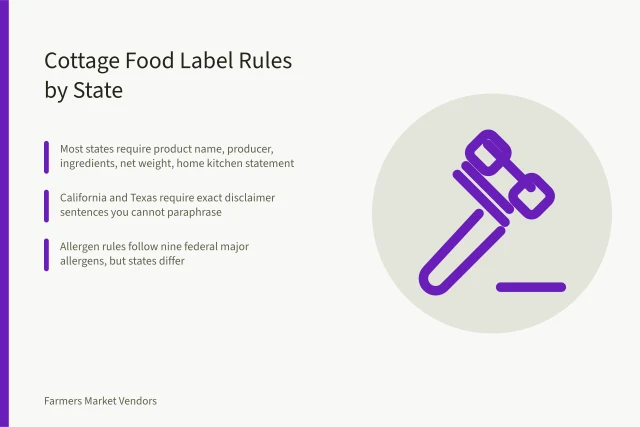
Four label elements are near universal. Product name. Producer name and address. Ingredient list with allergens. A home kitchen statement. If your label has all four, you are close in most states.
What is not universal is the permit number requirement, which California adds and Texas does not, and the exact wording of the home kitchen statement, which is prescribed in Texas and Illinois.
Practical advice: build your label template with the four universal elements, then add the state-specific line as a variable field. If you sell in more than one state, print separate runs.
Permits, inspections and county health department limits on home kitchens
County health department permits are the operational choke point for most home kitchen food businesses. The state writes the law, the county issues the paper.
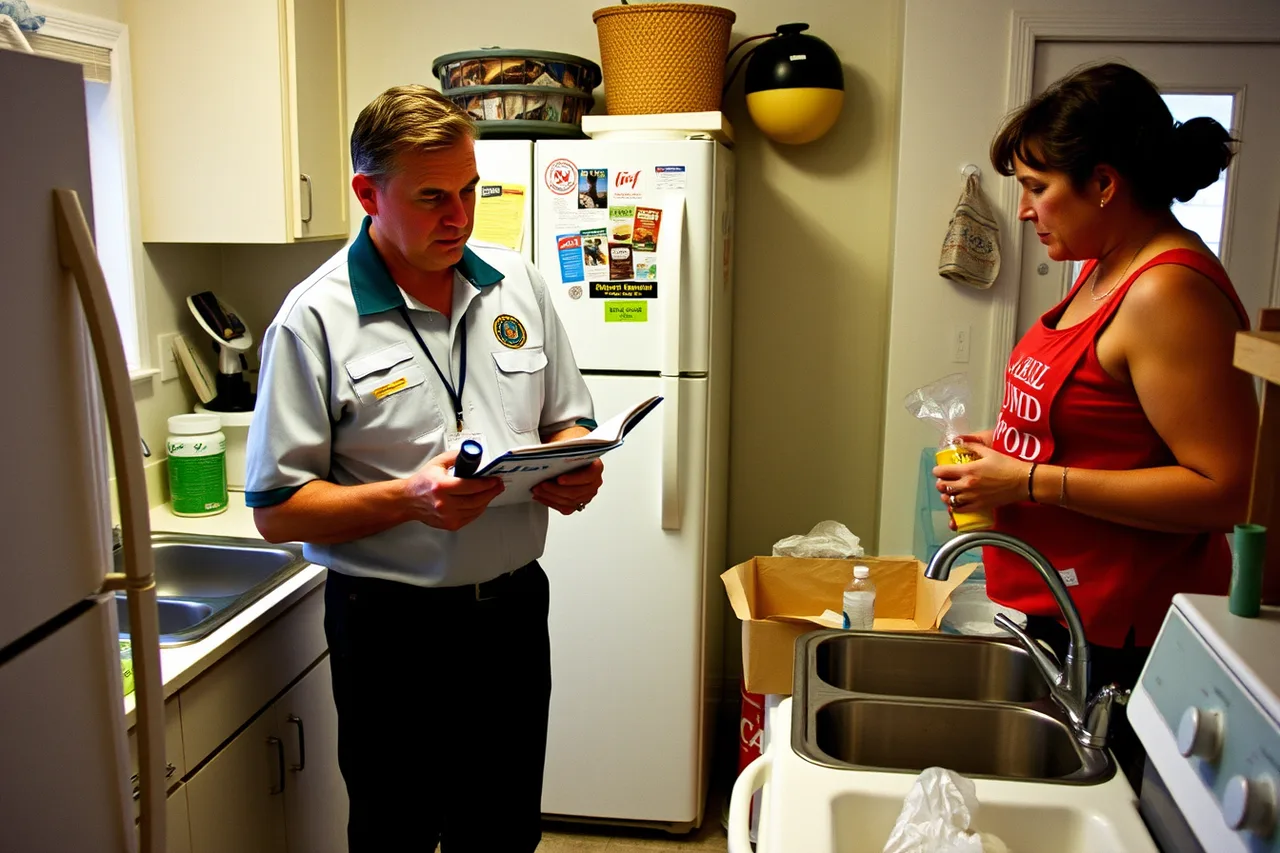
What counties actually do varies widely. Some counties register cottage food operations with a short form and a fee. Some require an inspection of the home kitchen before issuing a permit. Some do neither and only get involved if a complaint arrives.
An inspection is not a full restaurant inspection. It usually covers the kitchen's cleanliness, hand washing, pet and child access, storage of ingredients, and separation of cottage food work from household cooking.
Expect questions about your refrigerator, your sinks, your flooring, and whether the kitchen opens directly into a living area. A kitchen that doubles as a laundry room is a common problem.
Some counties also require a temporary food facility permit for each market event, separate from the cottage food registration. That permit is usually issued to the market or the vendor depending on local practice.
Fees are local. A cottage food registration might cost a modest annual sum while a temporary food facility permit costs per event, so budget for both if your county uses them.
Your license requirements at the market level are usually a stack: state cottage food registration, county permit, market vendor agreement, and a food handler card. Missing one stalls your first market day.
A few more limits worth knowing. Home kitchens cannot generally serve as a base for employees. You cannot hire help to cook in a cottage food kitchen in most states. Your home address goes on the label, which some vendors find uncomfortable.
If your county and your state disagree, the stricter rule usually governs. Call the county before you buy ingredients, not after.
Where cottage food rules stop and commercial kitchen rules begin
The line is drawn by risk and by channel, not by volume alone. Once you cross it, you need a licensed commercial kitchen, a food establishment permit, and inspections.
Four triggers push a home producer out of cottage food rules. Selling wholesale or to a retailer for resale. Shipping product across state lines. Selling a food that requires refrigeration. Exceeding the annual sales cap.
A fifth trigger is product type. Low-acid canned vegetables, canned meat, and anything requiring a pressure canner process are almost never cottage food items. They need a processed food registration or a commercial facility.
Commercial kitchen rules bring real costs. Rent for a shared kitchen, a food establishment permit, periodic inspections, commercial insurance, and often a certified food protection manager on site.
The upside is scale and channel. A licensed kitchen can sell to restaurants, ship by mail, and appear in grocery retail. Cottage food cannot do any of that in most states.
Some vendors run both. A cottage food operation for market sales and a licensed kitchen for wholesale. That structure is legal if the two operations are genuinely separate and the home kitchen is not used for the licensed business.
Your legal and insurance guide should be settled before you scale past the cap, because liability and coverage change with the license.
Watch for the cap. It is measured in gross sales, not profit, and it usually counts all cottage food sales across all channels. Track it monthly, not in April.
Selling cottage food goods as a farmers market vendor: practical compliance steps
Markets vary in how strictly they screen cottage food vendors. Some ask for your registration at application. Some ask on opening day. A few never ask, which does not make an unregistered vendor legal.
Work through these steps in order. The sequence matters because each step depends on the one before it.
Practical compliance steps
- Confirm your state's cottage food law and the current allowed products list, then confirm the annual sales cap.
- Register or obtain a permit with your county health department if your state requires it, and schedule any inspection.
- Complete the required food handler or cottage food training and keep the certificate where you can find it.
- Build a compliant label for each product, including allergens and the state's required home kitchen statement.
- Apply to the market, submit your documents, and pay the vendor fee and any temporary food facility fee.
- Set up sales tracking that separates cottage food revenue from any other income, and review it monthly.
- Keep records of registrations, training certificates, labels and sales for at least the period your state requires.
Before your first market day, run this checklist.
Market Day Compliance Checklist
- State cottage food registration or permit is current
- County health department permit or registration is on file
- Food handler or cottage food training certificate is valid
- Compliant label on each product including allergens
- Market vendor fee and temporary food facility fee paid
- Sales tracking separates cottage food revenue monthly
- Records kept for the period your state requires
Market managers are not regulators, but they carry risk if they host an unregistered vendor. Expect more paperwork at established markets and less at small ones, and do not read that as permission.
Your product mix is also a business decision. The inventory and sourcing choices you make at the start determine whether you can stay under the cap or need a commercial kitchen within a year.
If you are still at the idea stage, the decisions in starting a farmers market vendor business are worth settling before you register anything, because the legal structure you choose affects your taxes and your labels.
One tax note. Cottage food income is self-employment income. It goes on Schedule C, and you owe self-employment tax on the net profit. Set aside money as you sell, not at filing time.
If your market accepts SNAP or the WIC Farmers Market Nutrition Program, those transactions come with their own authorization rules. They are separate from cottage food law and are handled by the market or the state agency.
Finally, rules move. State legislatures adjust caps and product lists, and counties change fees. Check your state agriculture or health department page once a season, and check your county page before each market year.