Guides
Farmers market vendor daily workflow and SOP guide: the parts worth your time
A farmers market vendor daily workflow and SOP guide shows which setup, sales and teardown steps deserve your time and which you can safely skip.
What to take away
- Write one SOP per repeatable taskbooth setup, cold chain, token handling, cash reconciliation, teardown. If it happens every market day, it gets a page.
- Set your stall from the market's rules first. Stall size, tent weights, fire lanes and vehicle access come from the market manager, not from what fit last week.
- Keep the cold chain unbroken from pack-out to pack-in. Ice, coolers and shade are equipment decisions you make the night before, not at the booth.
- Confirm your permit layer before opening daymarket application, local health department, state cottage food rules if you make value-added goods, and any weights-and-measures check on scales.
- Track four numbers weeklysell-through by SKU, break-even per market day, margin by SKU, and cash on hand. The rest can wait.
This article covers business systems for market vendors, not individualized food-safety, labeling, weights-and-measures, tax or legal advice. Requirements vary by product, market and state. Confirm them with your market manager and your local health department, and where money or permits are involved, a CPA or attorney.
The stall is the first SOP
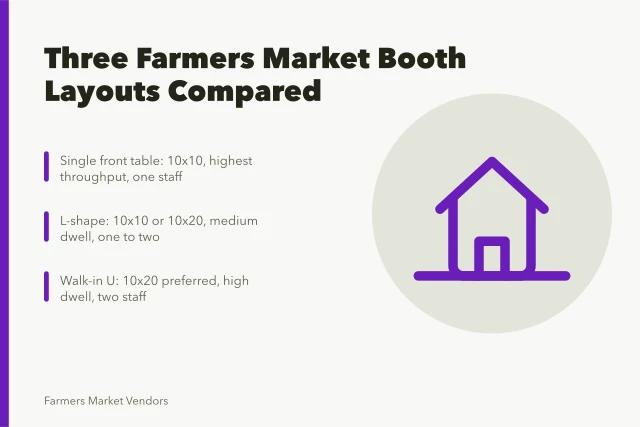
Booth setup is the task most vendors never write down, and it is the one that decides whether the first hour is calm or chaotic. A written setup has a fixed order: weights on the tent legs, tables placed to the market's frontage rule, signage squared, cash box and card reader positioned, product staged in the order it sells.
Setup order matters more than setup speed. Tent and weights first, product last. Price signs go up before the first customer arrives, not after someone asks.
Stall dimensions, aisle widths, tent weighting and vehicle access are set by the market manager and sometimes by the fire marshal. Ask for the current vendor handbook before you buy a tent. A setup that worked at one market can fail inspection at another two towns over.
The USDA's directory of farmers markets at Local Food Directories: Farmers Markets lists markets by state, with contact details the market manager or representative submits. Use it to find the manager to ask, not as proof of what any market allows.
Market-day workflow, hour by hour
Market day is a fixed sequence: load-out, setup, sales, breakdown, count. Write it once and run it every week. The sequence does not change much between a produce grower and a baker, but the timing does.
Market-day workflow
- the night before. Harvest or bake, chill to temperature, pack coolers, charge the card reader, print labels, load the vehicle in reverse order of setup so the tent comes out first.
- first 60 to 90 minutes. Weights, tent, tables, display, signage, cash float, card reader test transaction. Walk the stall once as a customer would.
- Sales. Restock from the back, keep the cold chain closed, log token and card sales as they happen, watch sell-through on the slowest SKU and adjust price or bundle before the last hour.
- Breakdown. Break down in the reverse of setup. Product and cash out first, then tables, then the tent, then the weights. Never leave a weighted tent unattended while you load the vehicle.
- Count. Count the cash and record sell-through before you unload at home, while the numbers are fresh. Note what sold out and what came home, and photograph the empty stall if the market requires it.
Write each block as a checklist with a name against every line. A task with no owner is a task that gets skipped on the day someone calls in sick.
One page, teardown SOP
Print it, tape it in the vehicle, and work it in order.
Teardown SOP
- Stop selling. Cover or close the display and turn the price signs in.
- Product into coolers first, ice refilled, lids shut.
- Cash box and card reader out of the booth and into the vehicle.
- Tables down and wiped. Covers folded, not balled up.
- Signs, cards and the float into the signage box.
- Canopy off, frame down, weights off the legs.
- Trash and scraps bagged and carried out. Leave the space as you found it.
- Vehicle loaded with tent and weights last, so they come out first next week.
- Sign out with the market manager if the market requires it.
Cold chain and display setup
Cold chain is the SOP that carries the most risk if it slips. Product goes from cold storage into a cooler or refrigerated unit, stays closed until it is displayed, and returns to cold storage at teardown. Every time the lid opens, the interior warms.
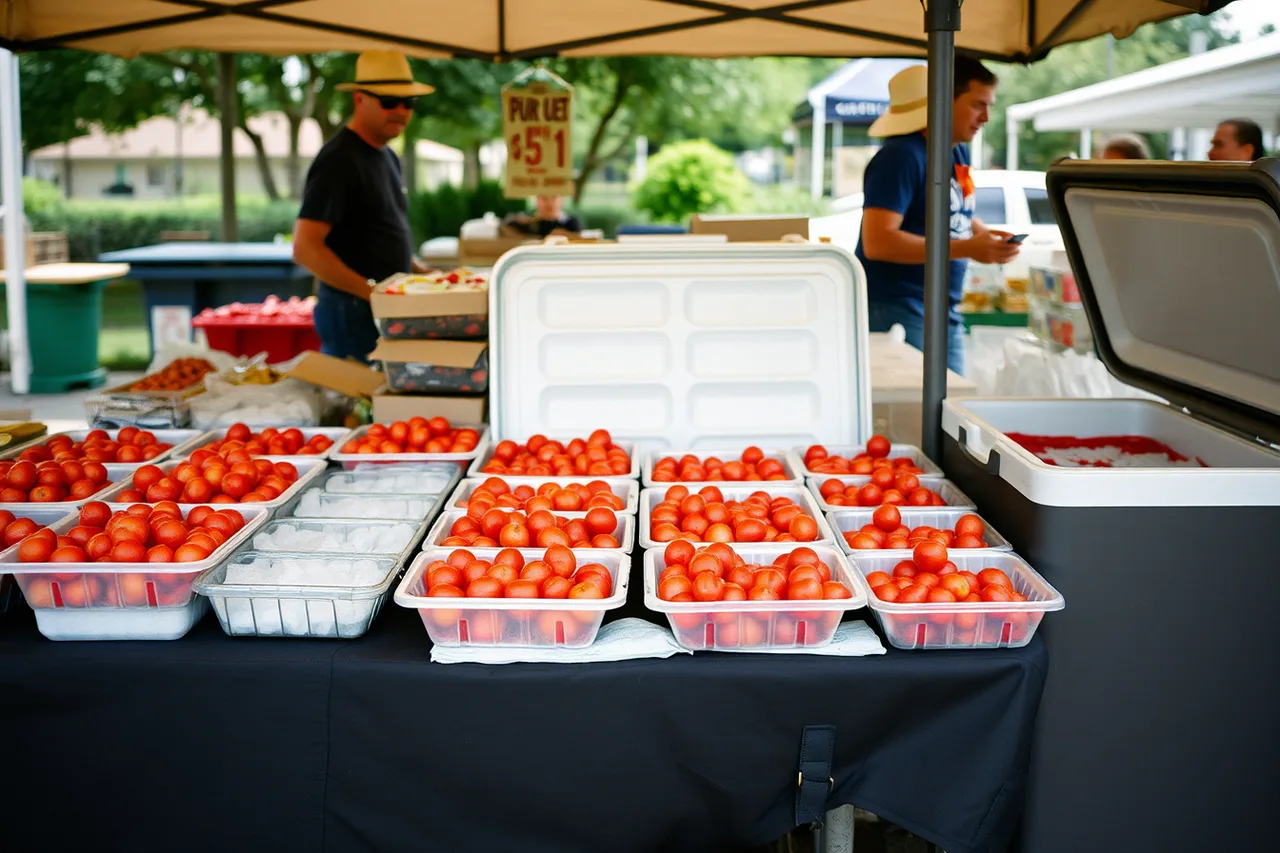
Display decisions trade visibility against temperature. A shaded table with product in shallow trays sells better than a deep cooler with the lid down, but only if you can restock fast enough to keep the trays cold. Freeze packs under the display, not on top of the product.
Food handling and temperature requirements are set by your local health department under the retail food code your state has adopted. The FDA keeps a state-by-state directory at State Retail and Food Service Codes and Regulations that points to the agency and code for your location. Read it to find your inspector, then ask the inspector directly.
If you handle or prepare food, a certified food handler course such as ServSafe or your state's equivalent is usually required. Take the course your health department recognizes.
Permits, tokens and the money side
Permit layers stack, and each one has a different office behind it. Your market application and stall fee go to the market manager. Food handling and sampling go to the local health department.
Sampling has its own rules. The local health department and your market manager both set them, and a permit to sample is usually separate from a permit to sell. Confirm you are covered before you hand out the first sample.
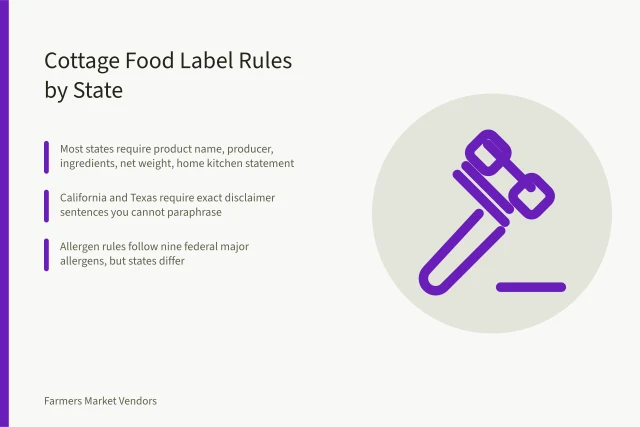
Value-added goods made in a home kitchen fall under your state's cottage food law, which sets what you may sell and where.
Scales used for selling by weight may fall under state weights-and-measures inspection.
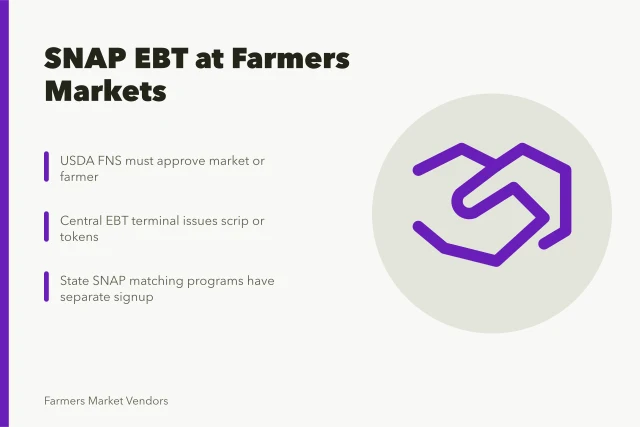
SNAP and WIC FMNP token handling is its own procedure. Tokens are issued, spent and redeemed on a schedule the market or state agency sets, and the paperwork has to match the tokens you turn in.
In most markets you log token and EBT sales on the market's token sheet as they happen, then hand in the tokens or scrip with the sheet at close.
The sheet carries columns for date, token type, tokens issued, tokens redeemed and your signature. Reimbursement follows a set cycle, often within one to two weeks, and the cycle is written into your vendor agreement. A late hand-in rolls your payment to the next cycle.
On the tax side, the IRS says a business may choose any recordkeeping system. The system must clearly show income and expenses. Keep documents for these transactions:
- purchases
- sales
- payroll
- assets
- other transactions See What kind of records should I keep?. Keep your market-day log and receipts weekly, not at year end.
Break-even per market day is arithmetic you do with your own figures:
- Market-day cost
- = stall fee + mileage + ice and supplies + card processing + any helper pay.
- Break-even units
- = market-day cost divided by your contribution margin per unit.
- Sell-through rate
- = units sold divided by units brought.
Run those three numbers after every market for a month. The pattern tells you which markets to keep and which SKU to drop.
Two cost lines are published and easy to check. Card reader rates vary, and a typical published in-person rate is about 2.6 percent plus 10 cents a transaction; confirm the current rate with your processor. Helper pay starts at the federal minimum wage of $7.25 an hour, and it is higher in states with their own minimum.
Stall fees and ice are local. A stall fee follows stall size, season length and whether the market takes a percentage of gross instead of a flat weekly charge; ask for the current fee schedule. Ice is a store purchase, so price it at your usual stop.
Staffing the booth
Booth staffing is a throughput decision, not a headcount decision. One person can run a small produce stall alone if the setup is right. A stall that also handles tokens, card sales, sampling and restocking needs a second set of hands at peak.
The Bureau of Labor Statistics describes food service managers at Food Service Managers. They handle several responsibilities:
- staff
- supplies
- food preparation
- sanitation
- customer issues
They often work nights, weekends and holidays. A market lead carries the same load in a smaller space.
Name one person as market lead for each market day, with authority to make price and pull decisions on the spot.
Write the role down: who opens the cash box, who watches the cold chain, who handles a token question, who calls the market manager if something goes wrong. A booth with no named lead defaults to whoever is closest to the customer, and that person is usually busy selling.
Example: a Saturday market day
A two-person produce and jam stall at a 20-by-12-foot space, with a 6 a.m. load-in and a 1 p.m. close.
- 5:15 a.m.Coolers loaded, card reader charged, cash float counted, labels printed.
- 6:00 a.m.Weights on, tent up, tables set, display staged, test card transaction.
- 7:00 a.m.Open. One person sells, one restocks and watches the cold chain.
- 10:30 a.m.Slowest SKU marked down. Token totals logged.
- 1:00 p.m.Close. Teardown in reverse, cash counted against the log, unsold product back to cold storage.
- 2:30 p.m.Log written: units brought, units sold, cash, card, tokens, notes.
The log takes fifteen minutes and replaces the guesswork that otherwise runs the next market day.
Common questions
How many SOPs does a market vendor actually need?
Four or five will cover most stalls: setup, cold chain, money and tokens, teardown, and one for whatever your product does that others do not. Write them short enough to read standing up. If a procedure runs past one page, it is probably two procedures.
Do I need a permit to sell at a farmers market?
Almost always, and usually more than one. The market application is the first layer, and food, cottage food, weights-and-measures and tax registrations may each add another. Ask your market manager for the current vendor requirements and confirm the rest with your local health department and state agency.
What should I track after each market?
Sell-through by SKU, break-even per market day, margin by SKU, and cash on hand. Those four tell you what to bring next week, what to price differently, and whether the market is worth the day. Everything else is detail you can add once the basics are steady.
What is the biggest mistake new vendors make?
Overstocking perishables and underpricing value-added goods. Both come from guessing instead of logging. Bring what you sold last time plus a small buffer, price from your cost and margin rather than from the vendor next to you, and let two or three market days of data correct the guess.