Guides
The referral engine inside a farmers market vendor business
Referrals at a farmers market come from the stall itself, from pre-orders and from how you handle market tokens, free samples and complaints.
What to take away
- A market stall is a referral channel that runs in public, so the display, the signage and the way you handle a complaint are the advertisement.
- Pre-orders convert a Saturday shopper into a named customer you can contact before the next market day.
- SNAP and WIC FMNP token handling is a referral decision, not just a checkout step; ask the market manager which tokens your stall accepts and how they are reimbursed.
- Keep referral sources in the same weekly books you use for booth fees, tent, tables, scales, POS, labels, insurance riders, mileage and spoilage.
- Nothing here replaces your state cottage food office, local health department, market manager, CPA or a licensed attorney.
Where market referrals actually come from
Most vendor referral advice was written for service businesses that sell by phone. A market vendor sells in a lane, in daylight, next to a competitor selling the same tomatoes. The referral is what a shopper tells a neighbor on Tuesday.
That changes what you track. Not clicks. Sign-ups, pre-orders, token redemptions and repeat faces at the same stall.
A shopper who buys once and never returns was a sale. A shopper who buys, asks your name, and comes back with a friend was a referral. Only one of those compounds.
The channel table for a market stall
Fits a farmers market vendor when
- Market-day following
- Regulars know your stall location and what you bring each week
- Pre-orders and a standing list
- Customers want a specific item held before you sell out
- Signage and visible work
- Your display, samples and pricing are readable from the aisle
- Token and benefit handling
- Your stall accepts SNAP or WIC FMNP tokens and staff know the process
- Local search and reviews
- Shoppers search your farm or business name before driving out
Weak point
- Market-day following
- Dies if you skip markets or move spots
- Pre-orders and a standing list
- You carry the risk if they do not collect
- Signage and visible work
- A cluttered table reads as leftovers
- Token and benefit handling
- Requires training and correct reimbursement records
- Local search and reviews
- Reviews are public, including the bad week
Each row costs something different. Pre-orders cost you a hold and a no-show risk. Signage costs a one-time print run. Token handling costs staff time and a reconciliation habit.
Referral channels for market stalls
Market-day following
- Fits when
- regulars know stall
- Weak point
- dies if skip
- Cost
- weekly presence
Pre-orders and list
- Fits when
- want item held
- Weak point
- no-show risk
- Cost
- hold and risk
Token handling
- Fits when
- accept SNAP or WIC
- Weak point
- training and records
- Cost
- staff time
Pick two rows to run properly this season rather than five badly. The local SEO checklist for farmers market vendors covers the search row in detail.
Compliance is the referral channel nobody lists
A vendor who gets shut down mid-season loses every regular at once. That is why permit and food-safety paperwork belongs in a referral article.
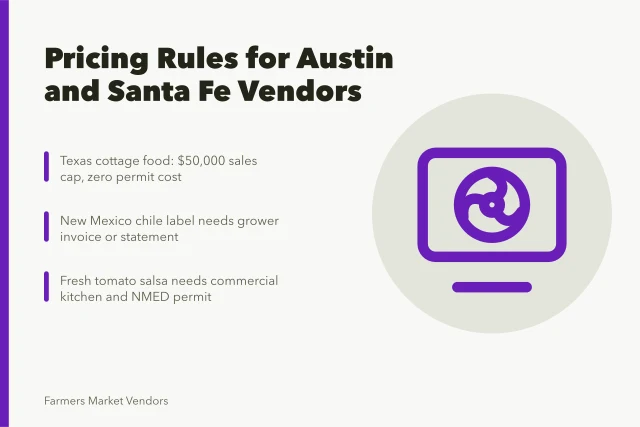
Cottage food rules, commercial kitchen requirements, labelling and weights-and-measures rules vary by state and by product. Confirm yours with your state cottage food office and your local health department. Food handling training runs through ServSafe or your county's equivalent course. Ask your market manager which permits the market itself requires on file.
SNAP and WIC FMNP token systems are set by the market and the state agency that funds them. Ask the market manager how tokens are issued, what your stall may sell against them, and when you are reimbursed. Get the answer in writing before your first token day.
Nothing above is advice for your jurisdiction. It is a list of the offices that give the answer.
What to write down, and who owns it
Give one person the job of keeping the stall's referral records. At a two-person operation that is the owner. At a larger one it is whoever runs the market day.
Keep these in one weekly book:
Weekly stall record book
- Booth fee and stall size
- Tent, tables, scales, POS, labels, ice
- Insurance rider and mileage
- Spoilage and unsold perishables
- Pre-orders taken, collected, abandoned
- Token redemptions and reimbursement date
Review the book weekly, not monthly. A monthly review hides a bad market day inside a good month.
Test one change at a time. If you add pre-orders, hold everything else steady for four market days and compare sell-through and repeat customers. A farmers market vendor business plan is where those decisions stay visible as you add markets or staff.
Reviews and local search, done within the rules
Google's own guidance says local results turn on relevance, distance and prominence, and recommends complete business information, current hours, reviews and photos. See Tips to improve your local ranking on Google. A verified profile also shows performance data for views, searches and customer interactions, which is a cheaper read on demand than guessing.
Review requests have rules. The FTC's guide for marketers says requests should go to genuine customers rather than a hand-picked set likely to respond well, and that incentives, connections or paid placement must not mislead. Read Soliciting and Paying for Online Reviews before you offer anything in exchange for a review.
A card in the bag asking for an honest review is fine. A discount for a five-star review is not.
Common questions
What is the cheapest referral channel for a market vendor?
The stall itself. Signage a shopper can read from the aisle, a consistent spot, and staff who know the product cost little and work every market day. Pre-orders cost more attention but convert a one-time buyer into a named customer.
Do I need a permit to give out samples?
Sample rules vary by product and by state. Ask your local health department and your market manager what your product category allows, and whether a certified food handler is required at the stall. Do not rely on another vendor's answer.
How do I know a referral change worked?
Compare sell-through, pre-order collection rate and repeat customers across four market days with everything else held steady. If only foot traffic moved, you bought attention rather than referrals.
Can I ask customers for reviews at the market?
Yes, if you ask everyone and offer nothing in return. The FTC guide linked above sets out why selective requests and incentives create a misleading picture.