Guides
Farmers market vendor markets worth entering
A ranked look at named farmers markets worth a vendor application in 2027, with the fee, permit and sell-through questions to ask each manager.
What to take away
- Seven named markets are worth an application for 2027GrowNYC Greenmarket, CUESA Ferry Plaza, Dane County Farmers' Market, Portland Farmers Market, Detroit's Eastern Market, Green City Market and Boulder County Farmers Markets.
- Score each one on stall fee against your own sell-through target. Crowd size alone says little about profit.
- Budget roughly $25 to $150 per stall day at these markets, plus membership or commission at some. Confirm the current figure with the manager before you apply.
- Most 2027 applications close between December and February for a spring start. Producer-only markets close earliest.
- A market 45 minutes away that lets you restock by noon beats a famous market four hours out.
The scoring method, before the market list
Start with arithmetic, not atmosphere. Break-even units equal stall fee plus mileage, spoilage and packaging, divided by your margin per unit. Run that figure for every market before you drive to any of them.
The full method, including how to set a margin per SKU, sits in our guide to farmers market vendor break-even points. A low fee at a saturated market costs more than a high fee in an empty category.
The scoring method
- Stall fee for the season, plus any membership fee or commission on sales
- Drive time and load-in window, in both directions
- How many vendors already sell what you sell
- Customer payment mixcash, card, SNAP or FMNP tokens
- Season length and how many market days you can genuinely work
Set a sell-through target before you visit. Vendors commonly aim for 70% to 85% on perishables. Below 60%, you are overstocking and paying to haul product home.
[figure 3]
Scorecard numbers to fill in
- 60%sell-through floor for perishables
- 4columns to weigh each market
- 1page scorecard per market
Seven markets worth an application in 2027
The USDA keeps a national directory of markets by state and season, and every manager sets their own vendor rules (Local Food Directories).
The table ranks nothing. It gives one differentiator per market, a fee band to plan against and the window when applications are normally read.
| Market | Where and when | Differentiator | Fee band per stall day | 2027 window |
|---|---|---|---|---|
| GrowNYC Greenmarket | New York City, about 50 sites, year-round | Strict regional producer rule; heavy SNAP and FMNP traffic | $40 to $120, sliding by site | Winter review; producer check first |
| CUESA Ferry Plaza | San Francisco, three days a week | Strongest prepared-food and value-added demand on this list | $50 to $150, category review | Spring and fall intakes |
| Dane County Farmers' Market | Madison, Saturdays, seasonal | Producer-only; produce and cheese crowded, meat thinner | Membership plus $30 to $70 | Winter review for spring |
| Portland Farmers Market | Portland, several sites | Downtown site is the competitive one; neighborhood sites have room | $30 to $90, per site | Late fall to early winter |
| Eastern Market | Detroit, year-round sheds | Indoor shed has long tenure; outdoor space turns over faster | $25 to $60, daily or seasonal | Rolling, winter push for spring |
| Green City Market | Chicago, year-round | Producer-only; chef buyers want steady volume and invoicing | $40 to $110, seasonal | Winter review, chef categories screened |
| Boulder County Farmers Markets | Boulder and Longmont, Colorado | Two-city circuit; cottage food and prepared food well represented | $30 to $80, per market | Early winter for the Boulder season |
Fee bands are planning ranges for markets of this size, not quotes from any single market today. Treat each window as a pattern, then confirm both in writing.
[figure 2]
Fee models at seven named markets
Greenmarket
- Location
- New York City
- Fee model
- Per-stall sliding
- Producer-only
- Yes
- Year-round
- Yes
Ferry Plaza
- Location
- San Francisco
- Fee model
- Per-day stall
- Producer-only
- No
- Year-round
- No
Dane County
- Location
- Madison
- Fee model
- Annual plus daily
- Producer-only
- Yes
- Year-round
- No
Portland
- Location
- Portland
- Fee model
- Per-market stall
- Producer-only
- No
- Year-round
- Yes
If this is a second or third market rather than your first, our guide to farmers market vendor expansion covers how to sequence applications without splitting stock too thin.
Application timing for the 2027 season
- In October and November, open the vendor page for each market on your shortlist and note the close date.
- Ask the manager two thingshow many stalls your category already fills, and when decisions go out.
- Submit before the close date. Producer-only markets verify your grow or make site, so they need lead time.
- Diary the same week next year. Returning vendors renew first, and late applications rarely get a first-choice stall.
Producer-only markets decide earliest. Markets that renew annual memberships decide in January or February.
Permits, tax and the token layer
Liability cover, and the gaps most market vendors carry, is set out in our guide to farmers market vendor insurance costs. Read it before you price a stall.
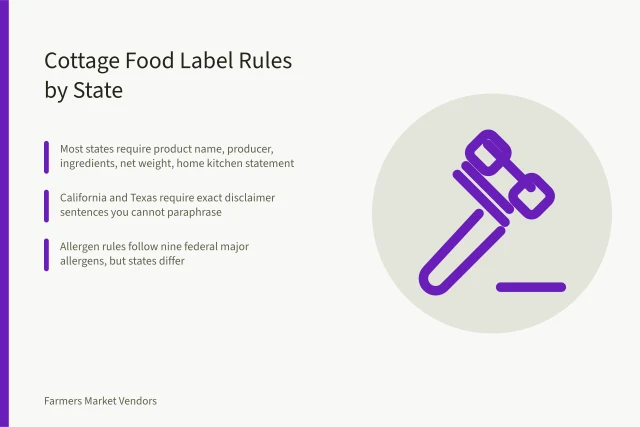
Cottage food rules differ by state: which products qualify, what the label must say and which sales channel is allowed. Anything needing refrigeration usually needs a commercial kitchen and a health inspection.
Most states require a sales tax permit before your first sale. The IRS directory of state government websites is the quickest route to your state revenue office (state government websites).
SNAP and FMNP token handling means a separate federal application and a weekly settlement trail. Ask the manager how tokens are issued and redeemed.
Canadian vendors at markets in Ontario or British Columbia register for GST/HST once revenue passes the small supplier threshold (GST/HST for businesses).
Where a fee decision gets made
Market A charges $120 a stall day and already has four bakeries. Market B charges $60, has no baker and sits 40 minutes closer. Same product, half the fixed cost, and a restock run at midday.
Fee is the smallest number on the sheet and the easiest to compare. Category room is the harder question, and it settles more choices than any crowd count.
A signed stall is the start of the work, not the end of it. Set the fee against what you actually sold, at least once a month, or last season's numbers will mislead you.
Once you trade, track sell-through, margin and fee per market every month. The figures to watch are listed in our monthly farmers market vendor KPIs.