Guides
Where farmers market vendor demand is heading
Farmers market vendor demand in 2027 turns on prepared food, SNAP and FMNP benefit tokens, and smaller stalls that sell out instead of discounting.
What to take away
Farmers market vendor demand in 2027 turns on five things: prepared food, benefit tokens, smaller units, cottage food rules, and who the buyer is.
- Prepared and ready-to-eat food is the fastest-growing stall category at many markets, and it carries the heaviest permit load.
- Token programs (SNAP, WIC FMNP, senior FMNP) put federal money in shoppers' hands, but only markets and vendors that finish the paperwork collect it.
- Shoppers increasingly want smaller quantities, so a full table at 1pm is a pricing problem, not a supply win.
- Value-added goods (jams, sauces, baked items) carry cottage food or commercial kitchen rules that differ by state and by product.
- Every one of these trends is checkable locallyask your market manager what changed in this year's vendor roster.
This article gives general farmers-market business information. It is not food-safety, labeling, weights-and-measures, tax, licensing or legal advice. Rules vary by product, preparation method, market and jurisdiction, so confirm current requirements with your market manager and the responsible authority.
Trend 1: prepared and ready-to-eat stalls are the growth category
The clearest directional change in vendor rosters is the rise of prepared and ready-to-eat stalls: hot food, coffee, baked goods sold by the piece, and value-added jars.
That demand is real because market shoppers now treat a market trip as an outing as well as a grocery run. They buy lunch, then vegetables.
The cost of serving that demand is a heavier permit stack. A prepared-food stall usually needs a food handler card, a local health department permit, and often a commissary or approved kitchen.
ServSafe, run by the National Restaurant Association, is the standard certified food handler course. State food handler cards typically cost $15 to $25 and last two to three years. It is the starting point, not the finish line.
Commissary kitchens rent space by the hour or month. Union Kitchen in Washington, D.C., The Hatchery in Chicago and Hot Bread Kitchen in New York all host food businesses, and most ask for a certificate of insurance before you cook.
Countertop readers from Square, Toast and Clover take tap and chip payments. Square's in-person rate is typically 2.6% plus 10 cents per tap. Confirm the exact stack with your local health department and your market manager.
Trend 2: SNAP and FMNP token money is the most underused demand channel
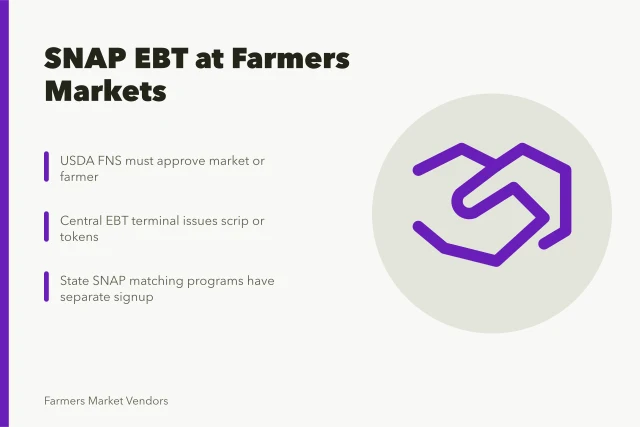
SNAP and the WIC and senior Farmers Market Nutrition Programs put spending power in shoppers' hands at the market gate.
Whether you can accept tokens depends on your market's participation and on what you sell. SNAP rules and FMNP rules are not the same, and eligibility differs by product.
MarketLink, run by the National Association of Farmers Market Nutrition Programs with USDA funding, gives eligible vendors a free EBT card reader and wireless service. Mobile Market+ is another common terminal at markets.
GusNIP, a USDA National Institute of Food and Agriculture grant program, funds matching incentives. Double Up Food Bucks, started by Fair Food Network in Michigan in 2009, matches SNAP spending at participating markets, usually capped at $10 to $20 per market day.
FMNP values are set by states. WIC FMNP vouchers often run $10 to $30 per participant per year, and Senior FMNP vouchers often $20 to $50 per season, in most states.
The market manager is the authority on which programs your market runs and what a vendor must do to be listed. Ask before the season starts, not in July.
Vendors who skip the paperwork watch token shoppers walk to the next stall. That is lost demand you can measure: count token transactions for one market day.
Trend 3: shoppers are buying smaller units
Bunches, pints, half-loaves and single servings are outselling bulk packs at many stalls.
This changes how you price. A smaller unit at a higher price per pound can beat a bulk price, but only if your cost per unit is known.
Track sell-through by SKU for four market days. If a category is gone by 11am every week, you are underpricing it. If it is on the table at close, you are overproducing it.
Half-share CSAs and preorder storefronts fit the same shift. Local Line and Barn2Door sell farm subscription software that typically runs $50 to $100 a month, so customers reserve a box before market day.
The pricing and profit guide walks through margin by SKU and break-even per market day.
Trend 4: cottage food laws split value-added products in two
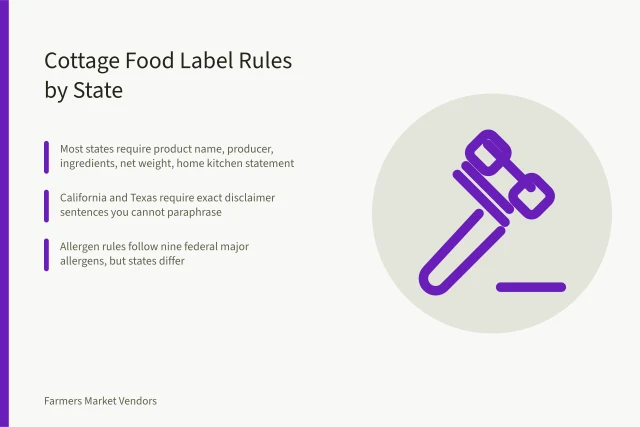
Cottage food laws let some vendors sell certain low-risk items made in a home kitchen. Which items, and what labeling they need, is set by your state's cottage food office.
California splits cottage food operations into Class A permits for direct sales and Class B permits that also allow indirect sales to shops and restaurants. Florida caps cottage food gross sales at $250,000 a year and requires a label line saying the food is made outside state food safety rules.
Texas widened its allowed list in 2019 under HB 970 and added delivery to customers. Higher-risk products generally require a licensed commercial kitchen. The line between the two is a state decision, not a market decision.
Labeling for packaged food comes from FDA rules in 21 CFR Part 101 and from your state. The FSMA preventive controls rule, 21 CFR Part 117, covers many processed foods, with exemptions for some small businesses.
Get the current text before you print a single label. If you are unsure which side of the line your product sits on, ask your state cottage food office or a licensed attorney. Guessing is expensive.
Where farmers market vendor demand comes from
Where vendor demand comes from
Fits a farmers market vendor business when
- Repeat market-day shoppers
- You have a set stall and regulars who ask for you
- Token and benefit programs (SNAP, WIC FMNP, Senior FMNP)
- Your market participates and your products qualify
- Pre-orders and CSA-style shares (Local Line, Barn2Door)
- Customers want a guaranteed box each week
- Local restaurant and grocer accounts
- You can deliver on a fixed schedule
- Commissary-based prepared food (Union Kitchen, The Hatchery)
- Shoppers buy lunch on site and your permit stack is complete
Weak point
- Repeat market-day shoppers
- Weather and market closure hit hard
- Token and benefit programs (SNAP, WIC FMNP, Senior FMNP)
- Paperwork and per-market rules
- Pre-orders and CSA-style shares (Local Line, Barn2Door)
- You carry the harvest risk
- Local restaurant and grocer accounts
- One buyer is one point of failure
- Commissary-based prepared food (Union Kitchen, The Hatchery)
- Higher fixed costs and health inspections
What to check before you commit to a trend
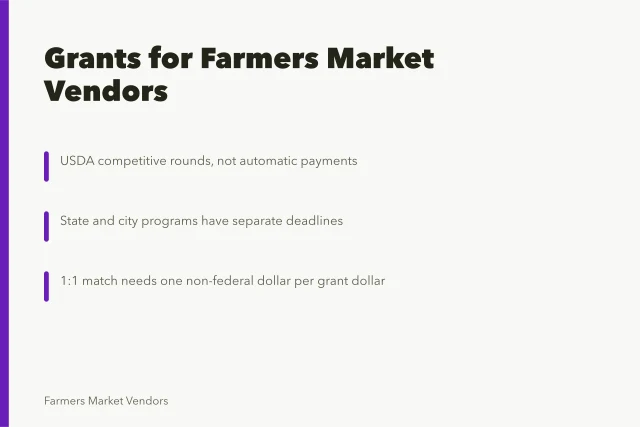
Put a number on the trend before you spend. USDA Farm Service Agency microloans run up to $50,000 for small farm operations. Farmers Market Promotion Program grants from USDA Agricultural Marketing Service typically range from $50,000 to $500,000, and they go to markets and organizations more often than to single vendors.
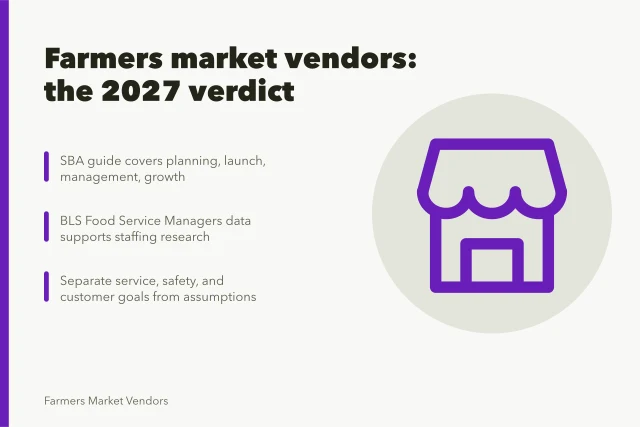
Use the SBA business guide for the planning, launch, management and growth side:
What to check before you commit
- market research
- startup costs
- permits
- insurance
- finance
- hiring
The BLS Food Service Managers page describes what running a food operation involves. The work includes these areas:
What to check before you commit
- staff
- supplies
- sanitation
- customer issues
- budgets and payroll records
This often happens on nights, weekends and holidays.
That staffing picture is why a written farmers market vendor daily workflow matters before you add a prepared-food line. If you are weighing a bigger roster of stalls or a new category for your own table, the farmers market vendor expansion beyond the obvious lays out what that growth actually asks of a vendor.
For market-level facts, the USDA Local Food Directories lists markets compiled from what managers and representatives submit. Eligibility, applications, product rules, insurance and fees still have to be confirmed with the market itself.
If a trend looks like it applies to you, test it in one market day before you rebuild your stall around it. One day of real numbers beats a season of assumptions.
Common questions
Is prepared food really the growth area?
At many markets, yes. Ready-to-eat stalls draw shoppers who stay longer and spend more per visit. The trade-off is the permit and equipment load, which you should price into the stall before committing. That means ServSafe or a state food handler card, a health department permit, and often a commissary lease.
Do I have to accept SNAP to stay competitive?
No, but you give up a funded customer segment if your market runs the program and you do not enroll. MarketLink supplies free EBT equipment to eligible vendors. Ask your market manager which programs operate and what vendors must do to qualify.
Are smaller portions worth the extra packaging?
Often, if your cost per unit is known and the price per pound holds. Run four market days of sell-through data by SKU before you change your whole table.
Where do I confirm what I am allowed to sell?
Your market manager for market rules, your local health department for food handling, your state cottage food office for home-produced goods, and a licensed attorney or CPA for anything with legal or tax weight.