Guides
Kitting out a new farmers market vendor business
A new farmers market vendor needs a tent, tables, scales, coolers, signage and a cash float before opening day, plus the permits each market requires.
What to take away
- The stall comes firsta weighted 10x10 canopy from Eurmax or ABC Canopy, two folding tables, a tablecloth that reaches the ground, and crates to raise produce to counter height.
- Weighing and money handling are separate purchasesan NTEP legal-for-trade scale from Brecknell or Ohaus, a cash box with a $150 to $300 float, and a card reader such as Square if your market has signal.
- Cold chain decides how much you can bring. Coleman or Igloo coolers, block ice, and insulated totes set the sell-through ceiling on a hot day.
- Permits are layered and local. Your state cottage food office, your county health department, and each market manager set different requirements.
- Nothing here is legal, tax, or food-safety advice. Confirm every requirement with the authority that sets it.
A farmers market stall is a shop you build and strike in one day. Everything you buy has to load into a vehicle, survive the trip, and come home clean. That constraint sorts the equipment list faster than any general business checklist.
The stall, in the order you will need it
Canopy and weights. A 10x10 pop-up tent is the standard footprint at most markets. Eurmax and ABC Canopy sell 10x10 canopies in the $130 to $250 range. The market manager decides whether your size and color are allowed.
Weight every leg with 30 to 40 pound sandbags or cast iron plates, about $20 to $35 each. On grass, auger anchors and straps do the same job. A gust that lifts an unweighted canopy takes your stock and your neighbor's with it.
Tables and risers. Two folding tables, 6 feet each, cover most layouts. A Lifetime 6-foot table runs about $60 to $110 at Walmart or Costco.
A fitted cloth that reaches the ground hides your storage boxes and reads as a finished stall. Milk crates or produce crates from Tractor Supply lift goods to counter height so customers are not bending to reach them.
Scales. If you sell by weight, your scale has to be legal for trade. Brecknell, Ohaus and Rice Lake sell NTEP-certified Class III scales, typically $150 to $400, and your state weights and measures program inspects them. Ask the market manager which scales other vendors use and what the inspector checks before you buy.
Cold chain. Coolers, block ice, and insulated totes hold temperature through a market day. A 70-quart Coleman Xtreme or Igloo cooler costs about $50 to $100, and Cambro or Polar Bear totes carry items you sell loose. A $10 to $20 digital thermometer in each cooler tells you when to add ice rather than guessing.
Money and signage. Bring a cash box with a fixed starting float of $150 to $300 in small bills, a price sign for every item, and a card reader if your site has reliable signal. Square charges 2.6% plus 10 cents per in-person payment, with no monthly fee. Write prices in a size a customer reads from two steps back.
Comfort and safety. Water, shade, a first aid kit, and a hand-wash setup where food handling is involved. Many vendors use a 5-gallon Igloo cooler with a spigot, a spare jug of water, soap and paper towels, about $40 total. Your health department sets what that setup must contain.
What the first buy costs
| Item | Named example | Typical cost |
|---|---|---|
| Canopy | Eurmax 10x10 pop-up | $130 to $250 |
| Leg weights | 40 lb sandbags or cast plates | $20 to $35 each |
| Tables | Lifetime 6-foot folding table | $60 to $110 each |
| Tablecloth | Fitted cloth to the ground | $25 to $60 |
| Scale | Brecknell or Ohaus NTEP Class III | $150 to $400 |
| Cooler | Coleman Xtreme, 70 quart | $50 to $100 |
| Insulated tote | Cambro or Polar Bear | $40 to $90 |
| Thermometer | Digital probe | $10 to $20 |
| Cash box | Steel cash box plus float | $30 to $50 box, $150 to $300 float |
| Card reader | Square reader | 2.6% plus 10 cents in person |
| Price signs | Laminated cards or chalkboard | $1 to $5 each |
| Hand-wash kit | Igloo 5-gallon cooler with spigot | $30 to $40 |
| Stall fee | Set by each market | typically $20 to $60 per day |
| Vendor insurance | $1 million general liability | typically $150 to $400 a year |
What the permits layer on top
Permits are the part new vendors underestimate. Three separate authorities can each stop you, and none of them talks to the others.
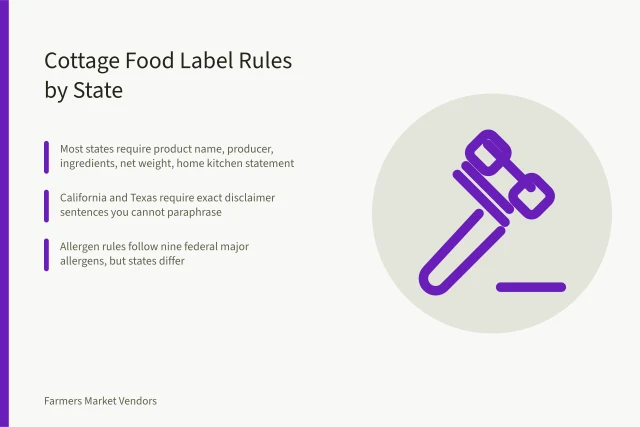
- Your state cottage food office sets what you may make in a home kitchen, what you may not, and what the label must say. California splits its cottage food permits into Class A, for direct sales to consumers, and Class B, for sales through stores and restaurants. Texas allows shelf-stable home-kitchen foods under its cottage food law.
- Your county or city health department sets food handling, sampling, and hand-wash requirements for anything beyond cottage food.
- Each market manager sets stall size, insurance minimums, product mix, and fees, and those rules differ between two markets in the same city.
The U.S. Food and Drug Administration: State Retail and Food Service Codes and Regulations directory lists the retail food agency for each state, which is where the search starts. The U.S. Department of Agriculture: Local Food Directories: Farmers Markets lists markets by state, though a vendor still confirms eligibility, fees, and insurance with the manager directly.
Worked example: sizing the buy to one market day
Say your tent, tables, cloth, scale and coolers come to a one-time $900. Your per-day costs are the stall fee, mileage, ice and spoilage, and card fees on card sales, which run about $45 at a small market.
Spread the $900 over the 20 market days you expect in a season, and it adds $45 a day. At a $20 average sale, $90 in daily costs needs five customers. If the number looks impossible, the fix is usually a smaller first purchase, not a bigger one.
Track sell-through by SKU for the first month. Anything that consistently comes home unsold is cash sitting in a cooler, and it tells you what to drop before you buy more of it.
Safety and the equipment you already own
For the physical setup, the Occupational Safety and Health Administration: Safety Management guidance on finding and fixing hazards applies to lifting, tent weights, and propane or generator use at a stall. Most of it costs nothing to follow.
Keep the rest of the list short. A hand truck from Harper or Magnuson, bungees, a tarp for rain, a trash bag for your own waste, and a clipboard for your pre-open check. Everything else can wait until a market day shows you it is missing.
Before your first market, walk the farmers market vendor equipment list against your actual load-out and strike anything you cannot carry alone.
Common questions
Do I need a commercial kitchen to sell at a farmers market?
Not always. Many states allow certain low-risk foods made in a home kitchen under a cottage food law. What you may make, and what the label must say, is set by your state cottage food office, so check there first.
What scale can I use?
If you sell by weight, the scale must be legal for trade and typically inspected by your state weights and measures program. Ask your market manager which scales other vendors use and what the inspector checks.
How much should I spend before my first market?
Spend enough to open safely and no more. Tent, tables, scale, and coolers cover a first day. Cash float and signage also cover a first day. Add equipment only after a market day shows you the gap.
Who do I ask about food handling rules?
Your county or city health department, and a certified food handler course such as ServSafe where your jurisdiction requires one. ServSafe Food Handler training runs about $15 to $30 online. Neither this article nor a market manager can substitute for that guidance.