Guides
State and Federal Grants for US Farmers Market Vendors
State and federal grants for US farmers market vendors: USDA, state ag departments, and city programs with match and reporting rules, plus free application help.
What to take away
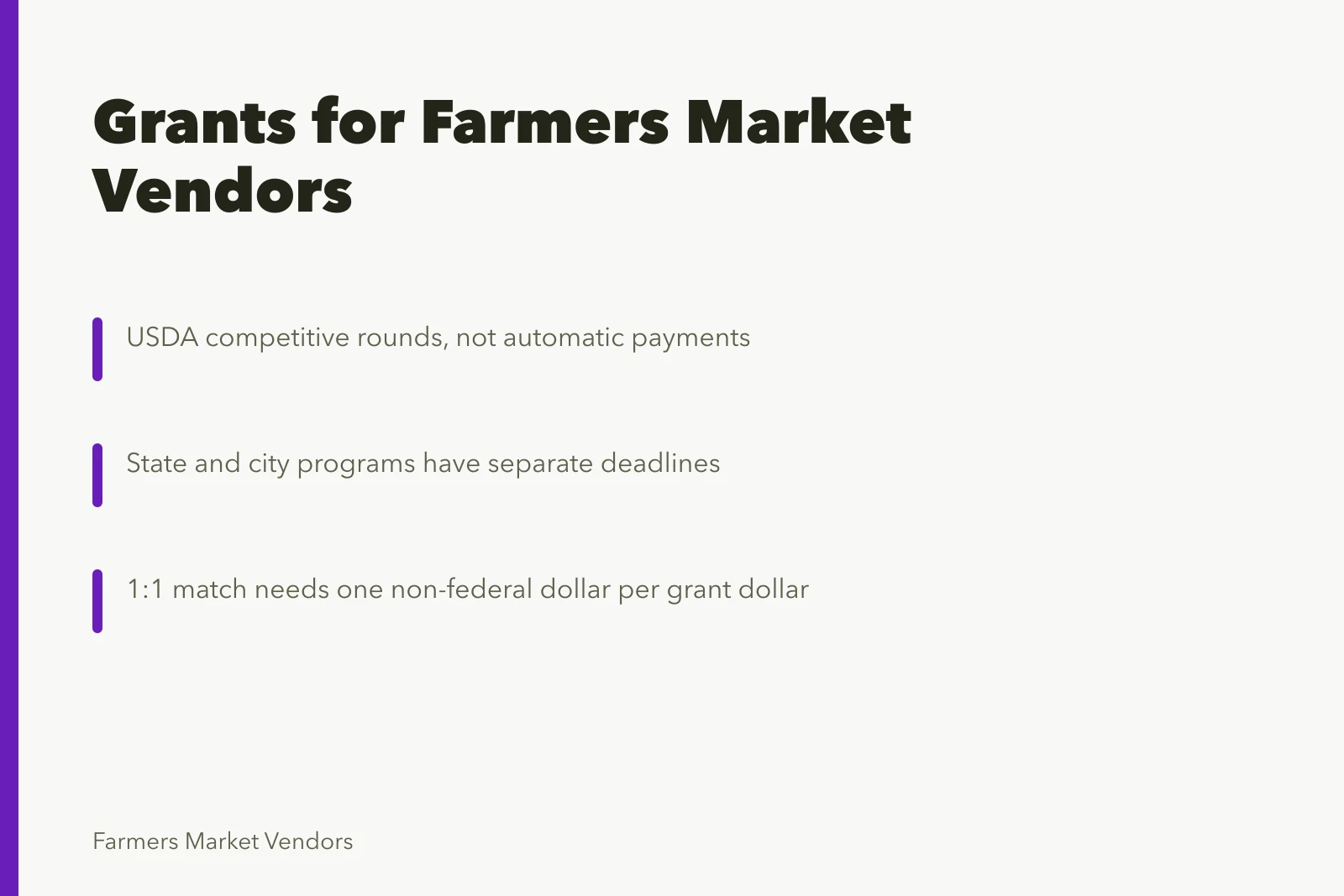
- Federal grant money for market vendors arrives through USDA competitive rounds, mainly the Farmers Market Promotion Program and the Local Food Promotion Program.
- Most state programs fund the market organization rather than the individual stallholder. Ask your market manager before you apply alone.
- Match and reporting decide whether you keep an award, not just whether you win one.
- Register in SAM.gov and Grants.gov before a federal round opens. Registration can take several weeks.
- Treat $2,000 to $25,000 as an illustrative first state award range, then check the agency's past award list.
Which federal programs a vendor can apply for
The two USDA programs direct-market vendors check first are the Farmers Market Promotion Program and the Local Food Promotion Program. Both are competitive.
FMPP funds projects that connect producers to consumers. LFPP funds local food moving between farms, processors and markets. Each round opens with a notice of funding opportunity that names eligible applicants and eligible costs.
| Program | Who applies | Main limit |
|---|---|---|
| FMPP | Farmers, market networks, nonprofits, local governments | Producer-to-consumer projects with match and federal reporting |
| LFPP | Local food businesses, market networks, nonprofits | Food moving between farms and markets |
| Specialty Crop Block Grant | State agriculture departments, then sub-grants | Specialty crops only, excluding most grains and oilseeds |
| GusNIP | Nonprofits, agencies, market networks | SNAP incentive programs, not general vendor costs |
| VAPG | Independent producers and co-ops | Value-added processing and marketing |
Filter by applicant type and by the limit that would block you first.
[figure 1]
Grant Source Comparison
Federal competitive
- Typical applicant
- Farm business, nonprofit
- Main limitation
- Requires match and federal reporting
State agriculture grant
- Typical applicant
- Individual vendor or small farm
- Main limitation
- Limited to in-state sales or production
City mini-grant
- Typical applicant
- Vendor at a named market
- Main limitation
- Tied to market season or location
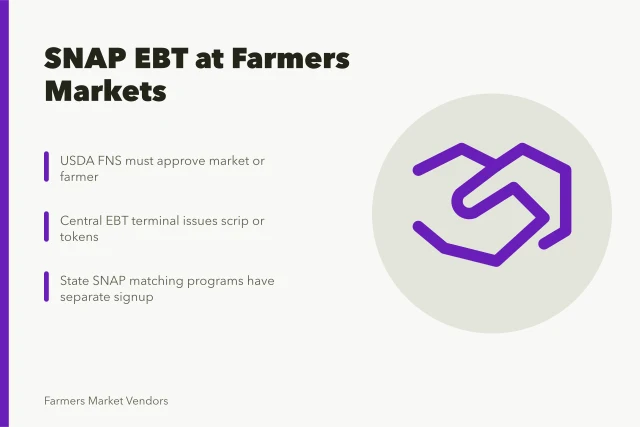
If your project buys SNAP terminals or token systems, how to accept SNAP EBT at farmers markets covers the retailer rules before you list that purchase as an allowed cost.
State and city programs, by name
State money sits with the state department of agriculture or a city economic development office. The IRS directory of state government websites links to each state, which is the fastest route to the right agency.
Named programs include:
- Vermont Farmers Market Access and Development Grantmarket access, SNAP and EBT, marketing.
- New York Farmers Market Grant Programinfrastructure, promotion and education.
- Pennsylvania Farmers Market Grant Programreimbursement of eligible market expenses.
- Virginia Farmers Market Grant Programmarketing and infrastructure.
- Minnesota AGRI Farmers Market and Local Food Promotion Program: market and local food projects.
- Wisconsin Buy Local, Buy Wisconsinlocal food sales projects.
- Massachusetts AFSIPfood safety equipment and upgrades.
Most of these name the market or a nonprofit as the applicant, so a vendor usually receives money through the market.
An award does not change what you collect on sales. US farmers market vendors' sales tax by state lists what each state requires a vendor to collect.
Ask two questions before you write anything. Who is the eligible applicant, and what match ratio does the agency require?
Award sizes vary by year, and a first state award often falls in the low thousands to the low tens of thousands. Treat $2,000 to $25,000 as an illustrative range and read the agency's past award list before you budget.
State rounds follow the state fiscal year, which starts July 1 in most states, so spring windows are common. Some programs review applications on a rolling basis instead. Fixed dates change every funding year, so the agency page, not an old notice, is the source to trust.
How to apply, step by step
- Get a Unique Entity ID in SAM.gov. It is free and can take a few weeks.
- Register in Grants.gov and wait for your role to be approved.
- Read the full notice of funding opportunity, including applicant type and eligible costs.
- Build the budget with a match ledger showing cash and in-kind value.
- Submit before the posted deadline. Federal portals close at a stated hour, usually Eastern.
Grant money is business income, so tax deductions for market vendors under IRS Schedule C matter for how an award lands on your return.
Expect to upload financial statements, a project narrative, a budget worksheet and letters committing your match. Small vendors often partner with a market association to carry the paperwork.
Federal notices usually appear in spring, with awards announced months later. Funds are released against a period of performance, so plan spending across the market season that follows.
What to keep after you win
- Signed notice of award
- Approved budget and match ledger
- Receipts for every grant-funded purchase
- Reporting due dates marked on a monthly calendar
- Proof of match, including volunteer hours
A missed report can pause the next payment. Keep a digital copy as well as paper, because agencies can ask for match proof years later. Note the name and email of your grant officer in the same folder.
The agency sends a reporting template with the award. Fill it in monthly.
Sorting grant-funded equipment from ordinary stock is simpler if you know what a farmers market vendor keeps in stock and who supplies it.
"Competitive" means scored against other applications. It does not tell you the pass rate or the likely award size, so read the past awards list.