Guides
Farmers market vendor startup costs explained, with realistic funding paths
A farmers market vendor's startup costs run from booth fees and tents to permits and cold storage, and each one has a funding path that fits it.
What to take away
- Farmers market vendor startup costs break into four bucketsthe stall, the permit layer, the cold chain, and the first inventory run.
- Booth fees are the cost most vendors underestimate. A $40 weekly stall across a 26-week season runs $1,040.
- Cottage food rules in your state decide whether you can start at home or need a commercial kitchen. That answer moves the budget more than anything else.
- A tent-only stall typically opens for $1,200 to $2,500. A permitted producer with cold storage and shared kitchen time usually needs $5,000 to $12,000.
- Fund the launch from pre-orders, an SBA microloan, a Kiva US loan, an Accion Opportunity Fund loan, or a market-run new-vendor discount before reaching for a credit card.
- Confirm every figure below with your market manager, county health department, and state cottage food office before you spend.
Where the money actually goes
Startup cost for a market vendor is not one number. It is four buckets that fill at different times, and the order matters because the permit layer decides what the other three can be.
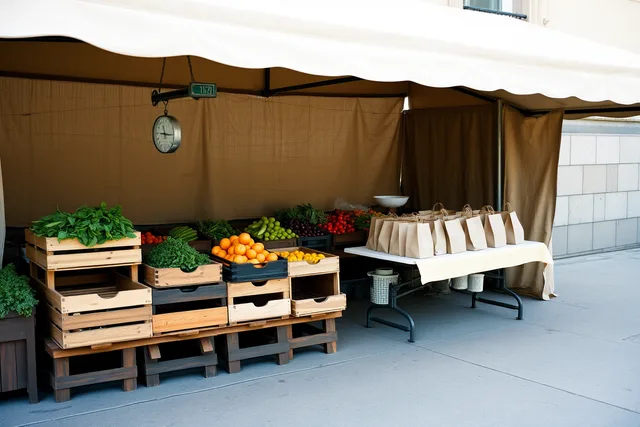
The stall comes first. A 10x10 pop-up tent from E-Z UP or Caravan Canopy typically runs $150 to $400. Four 40-pound leg weights add $60 to $120, and two six-foot folding tables from Lifetime cost about $50 to $90 each.
A floor-length tablecloth, a banner with your business name, a cash box, and $100 to $200 in starting change round out the stall. Add a legal-for-trade scale, usually $150 to $500, if you sell by weight.
The permit layer comes second. Your county health department issues the food permit if you handle or process food.
Temporary food permits typically cost $25 to $150 per event. An annual food establishment permit runs $150 to $700, and a cottage food registration with your state usually costs nothing to $250.
That registration decides whether a home kitchen is legal at all, and for which products. Some markets also require a vendor application, proof of insurance, and a signed rules agreement.
The cold chain comes third, and it is the bucket new vendors skip. A 60-quart Igloo or Coleman cooler costs $50 to $100. A rotomolded Yeti or RTIC runs $250 to $450.
A used commercial refrigerator or freezer lands between $300 and $1,500. A rained-out market with a full cooler is where this cost proves itself.
Inventory is the fourth bucket. Ball and Kerr eight-ounce jars typically sell for $1 to $1.50 each, or about $12 to $18 a case of 12. Printed labels run $0.10 to $0.60 apiece.
Seeds, ingredients, and packaging sit in the same bucket. This one scales with sales, so it is the easiest to fund from revenue once you are selling.
The costs, item by item
These are typical 2026 ranges for one 10x10 stall, not quotes.
| Item | What it is | How to fund it |
|---|---|---|
| Booth fee | Weekly or seasonal rent for your space, typically $25 to $75 a market day, or $200 to $1,000 a season | Pre-season savings, or a market's sliding scale |
| Market tent and weights | 10x10 canopy at $150 to $400 new, plus $60 to $120 in leg weights | One-time purchase, often used |
| Tables and display | Two six-foot folding tables at $50 to $90 each, risers, signage | One-time purchase |
| Scale | Legal-for-trade if you sell by weight, $150 to $500 for an NTEP-rated bench scale from Detecto or Ohaus | One-time purchase |
| Food permit | County health department license, $25 to $150 per event or $150 to $700 a year | Small business loan or personal savings |
| Cottage food registration | State filing if your state allows home production, free to $250 | Low flat fee, personal savings |
| Liability insurance | Rider covering market sales, typically $300 to $900 a year from carriers such as FLIP or ACT Insurance | Annual premium, sometimes bundled |
| Cold storage | Coolers at $50 to $450, then refrigeration at $300 to $1,500 used | Equipment loan or lease |
| Labels and packaging | Compliant labels at $0.10 to $0.60 each, jars at $12 to $18 a case | Rolls into per-unit cost |
| POS or cash handling | Square charges 2.6% plus 10 cents in person; PayPal Zettle lists 2.29% plus 9 cents | Monthly fee plus transaction rate |
| Commercial kitchen rental | Shared kitchen time at $15 to $40 an hour where home production is not allowed | Per-batch cost, folded into price |
| Pre-order storefront | Barn2Door or Local Line, typically $50 to $200 a month | Funded by pre-season deposits |
| Business registration and sales tax permit | State filing, often $50 to $300, plus a free IRS EIN | Personal savings |
| Mileage and fuel | Round trips to market and suppliers, tracked at the IRS rate | Tracked for Schedule C |
| Spoilage | Unsold perishables at day's end, often 5% to 15% of what you bring | Priced into margin, not ignored |
For the exact figures in your county, the market manager and the health department are the only sources that matter. Fee schedules change, and a number from a forum post two years old will not help you.
Funding paths that fit a market vendor
Pre-orders are the most underused path. If you sell baked goods, preserves, or any shelf-stable product, take orders before the season opens and use the deposits to buy packaging and pay your first booth fees.
Online storefronts such as Barn2Door and Local Line typically cost $50 to $200 a month. Deposits usually cover that before the first market day.
A small equipment loan covers the durable items: tent, tables, refrigeration. Community development financial institutions and some credit unions lend at this size, and the SBA's business planning and launch guidance walks through what a lender will ask for.
SBA microloans top out at $50,000, with an average loan near $13,000 through nonprofit intermediaries. Intermediary rates typically fall between 8% and 13%.
Accion Opportunity Fund writes small business loans from $5,000 to $250,000. Kiva US crowdsources up to $15,000 at 0% interest, repaid over about three years.
Some markets run their own new-vendor programs: sliding-scale booth fees, shared stalls, or a first-season discount. Ask the market manager directly, because these are rarely advertised.
Grants exist for beginning farmers and food businesses through state agriculture departments and USDA programs. The Farm Service Agency microloan reaches $50,000, and the Value-Added Producer Grant funds up to $250,000 in working capital.
Both are competitive and slow, and most USDA grants go to markets and nonprofits rather than to individual vendors. Treat them as a supplement, not a launch plan.
Personal savings and a credit card are the paths most vendors actually use. The IRS starting a business page is the right starting point for structure, tax ID, and recordkeeping before you spend anything.
Checks before you commit
Break-even per market day is the first check. Add your booth fee, mileage, and the cost of goods you brought, then divide by your average sale.
A vendor with a $35 booth fee, $12 in mileage, and $60 in goods needs $107 in sales to cover the day before earning a dollar.
Sell-through rate is the second. If you bring 100 units and sell 60, you are overstocking perishables and funding spoilage. Track it weekly for a season before you scale up.
Margin by SKU is the third. Value-added goods carry higher margins but also higher permit and labeling costs. Underpricing them is the most common mistake in this business.
Keep the books weekly, not at tax time. Schedule C deductions for mileage, booth fees, and supplies only help if you have the receipts. The IRS standard mileage rate was 70 cents a mile in 2025, so a 40-mile round trip is a $28 deduction.
A worked example
A vendor starts with a tent, two tables, a scale, and a card reader, roughly $800 of gear. The first market day sells out. The second runs long and leaves half a cooler unsold, which is normal in the first month.
Before the season starts, it helps to read 4 honest notes on farmers market vendor startup so the first month does not surprise you.
By peak harvest the calendar is fuller than the equipment. The choice is cold storage or turning away a market day. A used refrigerator at $500 to $800 costs the same as 12 to 20 market days at $40 a stall.
Vendors who survive this stage priced the market day to cover the slow ones, kept county health department paperwork current from week one, and asked every satisfied shopper for the next one.
If you are still deciding what to sell and where, Starting a farmers market vendor business: the decisions you cannot undo covers the choices that are hardest to reverse.
The USDA Local Food Directories: Farmers Markets lists markets by state, but each market's current eligibility, insurance, and product rules still come from the manager. Writing those decisions down early is what The plan behind a farmers market vendor business: what to write down is for.
Common questions
What is the biggest startup cost for a market vendor?
Booth fees over a full season usually exceed any single equipment purchase. A $40 weekly fee across a 26-week season is $1,040, more than a tent, two tables, and a scale together.
Do I need a commercial kitchen to start?
That depends on your state's cottage food statute and what you sell. Some states allow home production of shelf-stable goods, others do not. Your state cottage food office and county health department give the binding answer.
How do vendors fund their first season?
Pre-orders, a small equipment loan, and market-run new-vendor discounts cover most first seasons. Kiva US lends up to $15,000 at 0%, and SBA microloans average near $13,000. Grants help but arrive slowly, so most vendors combine two or three of these.
What should I track from week one?
Break-even per market day, sell-through rate, and margin by SKU. Track them weekly so you can adjust what you bring before the season ends, not after.