Guides
New York City Greenmarket permits vs Chicago neighborhood market rules
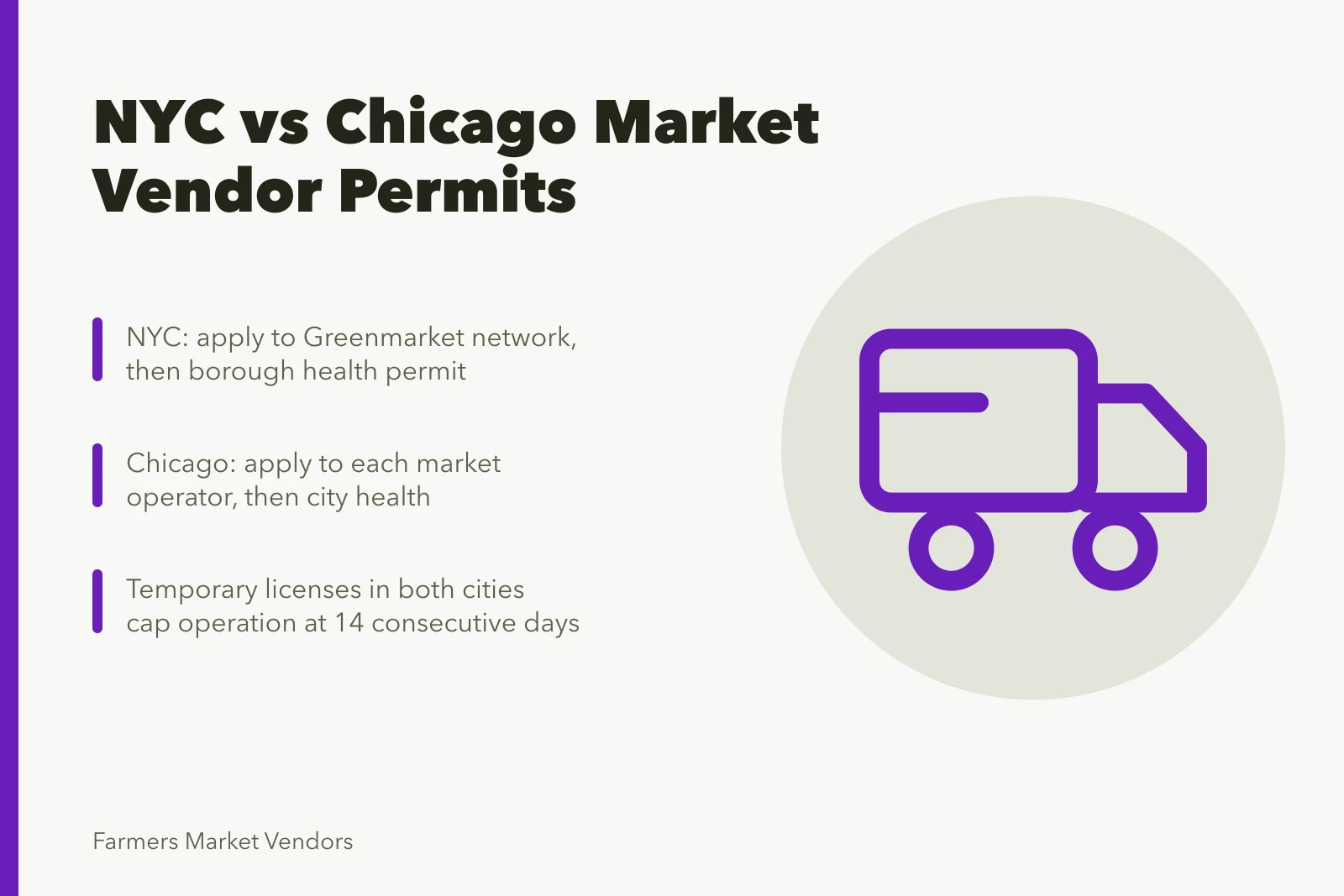
Farmers market vendors face two permit paths: NYC Greenmarket network permits with borough health rules, or Chicago city health department permits.
What to take away
- Farmers market vendors entering New York City apply to the Greenmarket network, then clear a borough health permit before the first market day.
- Farmers market vendors in Chicago apply to each market operator, then to the Chicago city health department for a retail food or temporary food establishment license.
- The short-term instrument is the temporary food establishment license in Chicago and the temporary food service establishment permit in New York City, and each is written for a named site and period.
- Stall fees run per market day and change with the site, while health fees go to the city, so budget both.
- Waitlists bite hardest at flagship sites such as Union Square, where a produce vendor can wait several seasons, while outer-borough and neighborhood markets open sooner.
Two market systems, two permit paths for a farmers market vendor
New York City and Chicago both host large, high-traffic farmers markets. They organize vendor entry in opposite ways, and that decides who you apply to first.
Permit paths: NYC vs Chicago
New York City
- First gate
- Greenmarket network review
- Market operator
- GrowNYC
- Health permit
- Borough health office
- Waitlist
- One network list
- Directory
- USDA national directory
Chicago
- First gate
- Each market operator
- Market operator
- City DCASE, chambers, nonprofits
- Health permit
- Chicago city health department
- Waitlist
- Every operator keeps own
- Directory
- USDA national directory
New York City routes most flagship markets through the Greenmarket network, operated by GrowNYC, which holds the stall roster for more than 50 market sites across the five boroughs. A producer applies to the network, not to a stall that happens to sit empty.
Chicago has no equivalent gatekeeper. The city runs its own downtown markets through the Department of Cultural Affairs and Special Events. Neighborhood markets on the North, South and West Sides are run by chambers of commerce, park groups and nonprofits such as Green City Market.
So in New York City you clear a network review and then a borough health permit. In Chicago you clear a market operator and the Chicago city health department separately, and every operator keeps its own waitlist.
The USDA national farmers market directory is the practical starting point for locating markets in either city before you commit to a permit path (Local Food Directories: National Farmers Market Directory | Agricultural Marketing Service). It lists more than 8,000 markets nationwide.
Both cities build on the same base. The FDA Food Code is the retail food baseline that state and local health departments adopt and then tighten, and its current edition dates from 2022 (FDA Food Code | FDA).
What each city controls
New York City
- Market entry
- Greenmarket network application
- Health permit
- Borough health rules, NYC Health
- Short-term license
- Temporary food service establishment permit
- Fee basis
- Per market day, plus health fee
- Waitlist
- Capped roster at each site
Chicago
- Market entry
- Individual market operator
- Health permit
- Chicago city health department permits
- Short-term license
- Temporary food establishment license
- Fee basis
- Operator fee, plus city health fee
- Waitlist
- Set by each operator
NYC Greenmarket network permits: application, fees and waitlists
Greenmarket network permits are the gate for the city's best-known sites, including Union Square, which runs four days a week all year.
NYC Greenmarket permit numbers
- 50+market sites in Greenmarket network
- $25 to $100typical stall fee per market day
- 4days per week Union Square runs
- 1 seasonwait at newer outer-borough markets
The application asks for your product list, where you grow or make it, your liability insurance, and how your line fits that market's mix. Reviewers balance categories, so a market never ends up with six jam vendors chasing the same customers.
Producer geography narrows the pool. GrowNYC draws from farms in the region around New York City, which in practice means upstate New York, New Jersey, Connecticut and eastern Pennsylvania.
Fees are charged per market day and by stall size, not as a cut of your sales. Vendors at the larger New York City markets commonly pay in the range of $25 to $100 a day, with outer-borough sites at the low end. The borough health permit is billed separately.
It is a flat city fee, and the amount depends on the permit period you buy.
GrowNYC fills stalls ahead of the season it is opening rather than year round, so applications are timed to the season you want to start.
The window typically runs from winter into early spring for a spring opening, and it closes for a market once that category is full. The exact deadline sits on the application page for each market, not in one citywide notice.
Waitlists are the real constraint. Union Square turns over slowly, so a produce applicant can wait several seasons for a stall. Newer outer-borough markets absorb qualified producers within about one season.
Apply to more than one market and more than one category. A vendor who names only Union Square will wait longest and may never land it.
Sort out your entity, insurance and tax registration before you file. Our guide to starting a farmers market vendor covers the choices that are hard to reverse later.
Steps to apply in New York
- Confirm your product category and check whether that market already has enough vendors in it.
- Gather proof of production, liability insurance and a New York State sales tax certificate.
- Submit the Greenmarket network application for every market you would accept.
- Wait for category review, then accept a stall offer when one opens.
- File the health permit with the borough office before your first market day.
New York City borough-level health rules and food handling
New York state food safety regulations apply to market vendors, and New York City enforces them borough by borough (Food Safety). Your inspection comes from the borough health office where you sell, not from one citywide counter.

Whole, uncut produce is the light path, and it is also exempt from New York sales tax. Cut, juiced, cooked or sampled food is taxable and pulls you into the New York City Health Code, Article 81.
A temporary food service establishment permit covers a short market run. It is written for no more than 14 consecutive days at one site, the limit the FDA Food Code builds into the definition of a temporary food establishment.
New York City and Chicago both treat short market selling as temporary, but the New York City permit is issued by the borough office and the Chicago license by the city department.
Inspection points are specific. Cold holding must stay at 41°F or below, and a handwash sink with hot and cold running water, soap and towels must sit within the food preparation area.
Any operation with food preparation needs a supervisor holding a New York City Food Protection Certificate. Prep work such as cutting or cooking also has to happen in a permitted commissary or commercial kitchen, not at home.
Common borough-level sticking points
- Cutting or sampling produce without a temporary food service establishment permit
- No supervisor with a New York City Food Protection Certificate on site
- Cold holding above 41°F when the inspector arrives
- No handwash sink within the food preparation area
- Prep done at home instead of a permitted commissary
Chicago city health department permits for neighborhood and downtown markets
Chicago food safety permits for market vendors run through the Chicago city health department, which licenses and inspects retail food establishments under Title 7, Chapter 7-38 of the Municipal Code (City of Chicago :: Food Safety).
Chicago vendor permit checklist
- Apply to each market operator separately
- Hold temporary food establishment license
- File one license cycle per market
- Keep certified food manager on duty for cooking
- Complete Illinois food handler training
- Ask operator how waitlist works
Unlike New York City, no single body holds the whole roster. You apply to each operator, then satisfy the city health requirements for your product. A full retail food establishment license renews annually.
Both Chicago licenses are billed by the city under the Municipal Code, and the temporary food establishment license typically costs in the low hundreds of dollars for a short market run.
The temporary food establishment license is what most market vendors hold. It covers a named site and period, so a vendor selling at four markets a month files four separate cycles.
Prepackaged low-risk goods need less. Cooking, assembling or serving on site requires a certified food manager on duty. Illinois food service sanitation manager certificates are valid for five years, and food handlers need their own training.
Chicago's market mix shapes the choice. Downtown markets, including the city-run Daley Plaza market through the growing season, draw heavy lunch traffic and reward prepared food. Green City Market in Lincoln Park uses a juried application each year.
Operators set their own stall fees and waitlists. Stall fees at Chicago neighborhood markets commonly sit in the range of $25 to $75 per market day, while downtown sites charge more, and some operators sell a season stall rather than a day stall.
Some run lotteries, some keep rolling lists, and some fill by invitation when a vendor leaves. Green City Market in Lincoln Park fills its roster through the annual juried application, so a vendor who is not placed in one season applies again in the next cycle. Ask what the list looks like before you pay.
A stall fee at a weak market is a worse deal than a waitlist at a strong one. Our breakdown of markets worth entering covers how to judge that trade.
Fees, inspections and waitlist realities compared side by side
Costs in New York City and Chicago both split into two pots, and the two come due at different points in the season. The market takes its stall fee before opening day, and the city takes its health fee on its own schedule.
Fees, inspections, waitlists compared
New York City
- Stall fee
- Per market day, $25-$100
- Health fee
- Temporary food service permit
- Duration
- 14 consecutive days
- Food manager
- NYC Food Protection Certificate
- Inspection
- Borough, unannounced
- Waitlist
- Long at flagships
Chicago
- Stall fee
- Set by each operator
- Health fee
- Temporary food establishment license
- Duration
- 14 consecutive days
- Food manager
- Illinois certificate, 5 years
- Inspection
- Risk-based cycle, at market
- Waitlist
- Short to long, by operator
In New York City, GrowNYC bills per market day, so a four-day week at a flagship site costs roughly four times a one-day outer-borough stall. In Chicago, each operator sets its own rate, and downtown sites charge more than neighborhood ones.
Inspection routines differ. Chicago's health department inspects retail food establishments on a risk-based cycle and checks temporary vendors at the market. New York City borough inspectors arrive unannounced during market hours, and a missing document can end your selling day.
What the comparison looks like in practice
New York City
- Stall or market fee
- Per market day by stall size, commonly $25 to $100
- Health fee
- Temporary food service establishment permit, flat city fee
- Food manager
- New York City Food Protection Certificate
- Waitlist
- Long at flagship markets
Chicago
- Stall or market fee
- Set by each operator, commonly $25 to $75 per day
- Health fee
- Temporary food establishment license, typically low hundreds of dollars
- Food manager
- Illinois sanitation manager certificate, valid five years
- Waitlist
- Short to long, by operator
A jam and preserve maker shows the gap. In Chicago, the Illinois Cottage Food Operation Act lets a home producer sell labeled jars directly to customers at farmers markets, with the operator's license on top. The same vendor in New York City needs a licensed facility, a borough permit and a network placement first.
Use a compliance checklist for new owners to line up insurance, tax registration and labels before either city's paperwork starts.
Once you hold one market, adding a second is easier. Our expansion and market guide covers how vendors stack markets without breaking health rules.
Which city is easier for a new vendor to enter
Chicago is usually the faster entry. No central network gate, more operators, a temporary food establishment license that fits a market season, and cottage food rules that let a home producer start selling.
Which city fits your product
What do you sell?
Prepared food -> Chicago downtown or NYC flagship
Produce or pantry -> Chicago neighborhood markets
New York City pays better per market day at flagship sites. The cost is time: network review, category competition and a borough permit before your first sale.
Choose by product. Prepared food vendors do well downtown in Chicago and at high-traffic New York City markets. Produce and pantry vendors find Chicago neighborhood markets more forgiving on fees and waits.
Read the underlying license requirements for each state before you file, since New York and Illinois differ on registration and labeling.