Guides
4 USDA AMS resources every US farmers market vendor should use
US farmers market vendors can use four USDA AMS resources for market research, direct sales data, advocacy and SNAP EBT rules that shape a selling season.
What to take away
- Four free federal resources cover one seasonthe AMS Farmers Market Directory, NASS direct sales data, the AMS FMPP grant, and the FNS SNAP rules.
- The directory lists markets, seasons and SNAP status, so you can target booths before you pay a fee.
- The 2022 Census of Agriculture puts direct-to-consumer sales above $3 billion, against about $2.8 billion in 2017.
- FMPP awards in recent program years have run from roughly $50,000 to $500,000, and go to market associations rather than one stallholder.
- FNS sets SNAP eligibilitystaple foods for home preparation qualify, and hot prepared food does not.
The four resources, named and placed
| Resource | Exact USDA page | What it does for your season |
|---|---|---|
| AMS Farmers Market Directory | Local Food Directories: Farmers Markets | Finds markets on your route and shows SNAP and WIC status |
| Direct sales data | Local Food Marketing Practices Survey and the 2022 Census of Agriculture | Benchmarks sales per market day against your state |
| Farmers Market Promotion Program | AMS FMPP | Pays for EBT systems, manager hours, marketing and training |
| SNAP and EBT rules | FNS SNAP: Farmers Markets | Sets eligible items, token systems, signage and reimbursement |
The AMS Farmers Market Directory for picking targets
The USDA AMS farmers market directory is the fastest way to see which markets exist along a route. Entries carry season dates, hours and accepted payment types, including SNAP and WIC status.
Filter by state, then by winter operation. Regions that still add vendor slots are worth the drive, and markets worth entering maps them.
[figure 1]
Directory session checklist
- Pull markets within two hour drive
- Filter by state and year round
- Check SNAP and WIC status
- Confirm season dates and booth fee
- Ask how many vendors sell your category
- Cross-check route and stack stops
Listings are self reported, so entries go stale. Call before you drive, and ask the same questions each time.
Picking targets
- Season dates, days and rain policy
- SNAP and WIC FMNP status
- How many vendors already sell your category
- Booth fee, and whether a tent is included
Adding a market is a capacity decision. Without more product or more hands, a fourth market splits the sales you already have.
What the direct sales figures actually say
The Local Food Marketing Practices Survey sits in the Census of Agriculture series. Its 2017 release put US direct-to-consumer sales at about $2.8 billion. The 2022 Census of Agriculture reports above $3 billion.
Both releases break the money down by state, farm size and marketing channel. Farmers markets, farm stands, CSAs and online sales are counted separately.
A minority of farms account for most of the dollars, and the typical direct market farm is small. The KPIs owners should track carry that benchmark between releases.
Treat your state row as a boundary line, not a target. Beat the state average per market day and you can absorb a higher booth fee. Fall short, and check pricing before foot traffic.
The Farmers Market Promotion Program
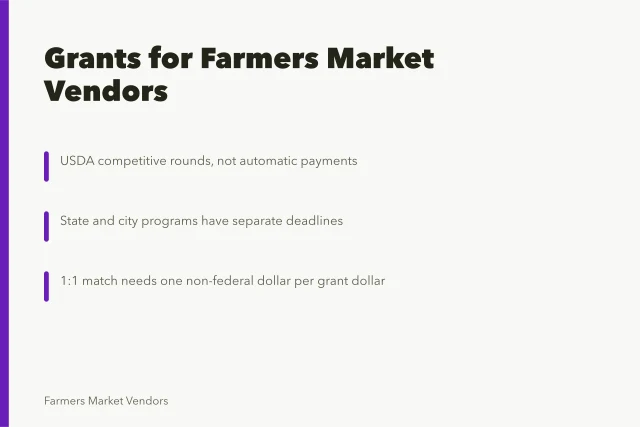
The Farmers Market Promotion Program funds marketing, consumer education, training and equipment for markets and direct producer operations.
Individual vendors rarely hold an FMPP award alone. Applications usually come from a market association, a nonprofit, a cooperative or a local government applying for several producers.
In recent program years, awards have ranged from roughly $50,000 to $500,000. Notices typically close in late winter or early spring, so read the open notice rather than last year's summary.
Vendors help by documenting need. Count your SNAP transactions and hand the board a one page case, kept inside the business plan.
SNAP and EBT rules, and where AMS fits
SNAP rules for markets come from FNS, not AMS. The FNS page on SNAP at farmers markets explains what a market must do to stay authorized.
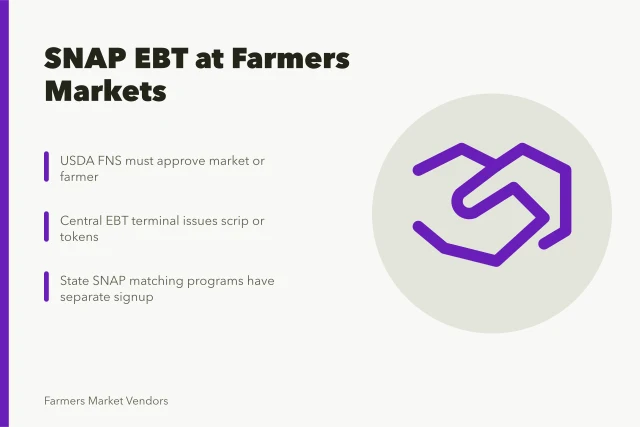
Most markets apply as one SNAP retailer and run a central booth. Customers trade benefits for tokens, and the market reimburses each vendor.
[figure 2]
SNAP token flow at market
- Customer swipes EBT card at central booth
- Customer receives wooden tokens or paper scrip
- Customer buys eligible food from vendors
- Vendors redeem tokens at end of market
- Market reimburses vendors
Eligible items are staple foods for home preparation:
SNAP and EBT rules
- Fruits and vegetables
- Meat, poultry and fish
- Dairy, breads and cereals
- Seeds and plants that grow food
Hot prepared food, alcohol, tobacco and non food goods are not eligible, and signage must separate them.
AMS grants often pay for the terminal, the tokens and the booth staff. Because the paperwork overlaps with WIC, the SNAP and WIC compliance guide is worth a pass before your first EBT market day.
Why the Farmers Market Coalition is grouped with the federal tools
The Farmers Market Coalition is a national nonprofit, not a USDA agency, so it is not one of the four. It sits beside them because federal money and federal rules reach individual vendors through it.
The Coalition lobbies for FMPP funding and SNAP equipment support, and publishes SNAP guides and policy templates. Membership is usually held by a market.
One season, four checkpoints
- Januarypull the AMS directory for every market in driving range. Log dates, days, SNAP status and manager names.
- Februaryread your state rows in the survey and the 2022 Census, then write your own revenue per market day beside them.
- Marchask whether your market belongs to the Farmers Market Coalition, and request its SNAP and metrics toolkits.
- Aprilwalk the SNAP rules against your token system, and confirm eligible items, signage and the payment schedule.
- Mayask your board to review the open FMPP notice, and offer your sales data as evidence.