Guides
Sourcing from local farms vs wholesalers for Asheville and Atlanta vendors
Farmers market vendors in Asheville and Atlanta weigh local farm sourcing against wholesale case pricing on cost, labeling and customer trust.
What to take away
- Farmers market vendors in Asheville and Atlanta rarely choose one supply chain. Most run both local farm sourcing and wholesale sourcing for vendors, splitting the stall by crop and season.
- Local farm cost per unit is higher and less predictable than wholesale case pricing, but it buys the story, the freshness and the traceability that shoppers pay for.
- Labeling and traceability rules follow the product, not the stall. Resold wholesale produce cannot borrow a farm name, and organic claims need certified paperwork.
- Customer perception in Asheville's farm-to-table scene rewards named growers. Atlanta market demand rewards variety, volume and all-season availability.
- A written sourcing plan, a cost sheet per SKU and honest signs do more for margin than any single supplier switch.
Local farm sourcing versus wholesalers for Asheville and Atlanta vendors
Two supply chains feed a Southern market stall. One runs through farms within a short drive of the city. The other runs through a terminal market or broadline distributor that trucks produce in from growing regions across the country.
In Asheville, the first chain dominates the brand. Buncombe County and the surrounding mountain counties hold small farms that sell heirloom tomatoes, salad mix, apples and pasture-raised eggs through the growing season. Vendors who buy there sell a place as much as a vegetable.
The names carry weight. Hickory Nut Gap Farm in Fairview, Full Sun Farm in Weaverville and Flying Cloud Farm in Fairview are farm names Asheville shoppers already know.
Atlanta is different. The city sits inside a long growing season, and the State Farmers Market in Forest Park moves volume from Georgia, Florida and beyond. Vendors there can restock midweek and keep a full table through winter.
Atlanta produce houses such as Nickey Gregory Company and FreshPoint Atlanta supply restaurants and larger buyers, and they quote by the case. Typical winter quotes run about $18 to $32 for a 25-pound case of field tomatoes, and $18 to $28 for a 24-head carton of romaine.
Local farm sourcing means small lots, cash or short terms, and gaps when a crop fails. Wholesale means case minimums, cold-chain handling and produce that every other stall can also buy.
The practical answer for most vendors is a split. Buy the signature crops locally and fill the rest from a wholesaler. That keeps the table full without giving up the farm story.
Start with a written plan. Our guide to inventory and sourcing walks through the seasonal buying calendar that keeps both chains in balance.
What local farm sourcing and wholesale case pricing deliver
Local farm sourcing
- Unit cost
- Higher per pound, varies by farm and week
- Minimum order
- Often a few flats or a single crate
- Lead time
- Days to weeks, weather dependent
- Traceability
- Grower known by name
- Season
- Peak months only
- Story value
- High in farm-to-table markets
Wholesale case pricing
- Unit cost
- Lower per pound, quoted by the case
- Minimum order
- Full case or pallet
- Lead time
- Same day to 48 hours
- Traceability
- Lot number, sometimes country of origin
- Season
- Year round
- Story value
- Low unless the grower is named
Cost per unit: local farm pricing against wholesale case pricing
Start with the per-unit numbers. Local washed salad mix at a typical $3.50 a pound fills four bags, near $0.88 a bag. A wholesale 3-pound case at a typical $28 loses trim and yields about ten sellable bags, near $2.80 a bag.
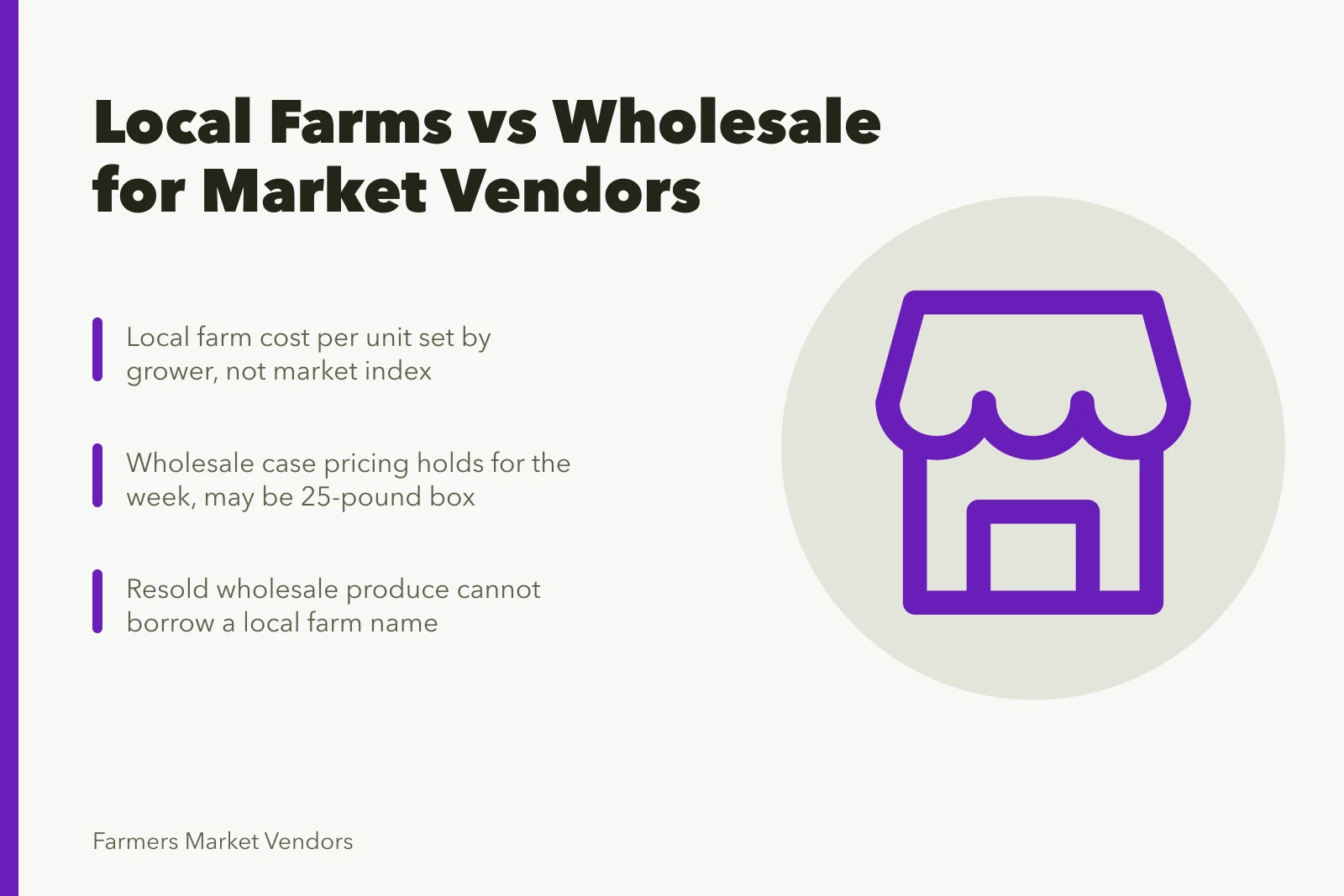
Local farm cost per unit is set by the grower, not by a market index. A small farm prices a crate of tomatoes to cover seed, labor, fuel and a living. That number moves with rain, heat and pest pressure.
Local vs wholesale cost per unit
Local farm
- Price basis
- Grower sets
- Unit
- Per pound
- Terms
- Cash or short
- Supply risk
- Crop gaps
- Math
- Per sellable unit
Wholesaler
- Price basis
- Weekly quote
- Unit
- Per case
- Terms
- Case minimums
- Supply risk
- Cold chain
- Math
- Per sellable unit
Wholesale case pricing works the other way. A distributor quotes a price per case for a grade and size, and the price holds for the week. The trade-off is that the quoted case may be a 25-pound box when you sell 8 pounds a day.
Run the math per sellable unit, not per case. Divide the case price by the pounds that reach the table after trim and spoilage. That number is what you compare against the farm price.
Local food marketing data shows direct sales have become a real channel for U.S. farms, which keeps grower prices firm in strong markets (USDA local food marketing statistics).
Demand for local food has also held up across income levels and regions, which supports premium pricing in cities with an active food culture (ERS local foods research).
A worked example
A vendor sells salad mix at $4 a bag and moves 60 bags a week.
- A local farm quotes $3.50 a pound for washed mix, and a pound fills 4 bags.
- A wholesaler quotes $28 for a 3-pound case of spring mix, and after trim 2.5 pounds reach the table.
- The local mix costs less per bag here because the yield is higher and the trim is lower.
- The wholesaler still wins in January, when the local farm has no mix at all.
Compare the two on a cost sheet per SKU, updated weekly. Our pricing and profit guide shows how to fold that sheet into a stall price.
Hidden costs on both sides
Local farm sourcing carries pickup fuel, cash flow pressure and the risk of a short crop. Some farms want payment before harvest, which ties up cash in a slow month.
Wholesale carries case waste, cold storage and the labor of sorting out bruised fruit. A case that sits two days too long is a total loss.
Our stock control checklist covers the counts and rotation rules that stop shrink on either chain.
Labeling and traceability differences between the two sourcing paths
Labeling is where the two chains diverge most, and where vendors get into trouble. A sign that says local means the produce was grown by a farm you can name and place.
What goes on the sign
- Farm name and county for local items
- Distributor or country for resold items
- Organic certificate for certified produce
- USDA grade terms only if met
- No local claim on resold produce
Resold wholesale produce is not local. It can be sold, and sold well, but the sign has to say what it is. Country of origin and a distributor name are the honest labels.
Traceability matters when a customer asks. For local sourcing, the answer is the farm, the field and the harvest day. For wholesale, the answer is the lot number on the case.
Grading is separate from sourcing. USDA grades and standards define what a U.S. No. 1 tomato or a Grade A egg actually is, and a vendor who uses those terms should meet them (USDA grades and standards).
Organic is a certification claim, not a vibe. If a sign says organic, the produce needs a certified operation behind it, with the paperwork to match (USDA organic certification).
Advertising claims for resold goods fall under federal truth-in-advertising rules. A vendor who mislabels origin or method can face a complaint from a customer or a competitor (FTC business guidance).
Sign rules for local and resold produce
- Farm name and county for every local item
- Distributor or country of origin for every resold item
- Organic certificate on file if the word organic appears
- Grade claim matched to the actual product
- Price per unit posted, including per pound where sold by weight
- Harvest or pack date on washed and cut items
- A single sign style so local and resold items are easy to tell apart
Customer perception in Asheville's farm-to-table scene
Asheville shoppers read signs. The city built a food identity on mountain farms, restaurants and a tourist trade that comes for the weekend and buys the story.
That makes the grower name an asset. A stall that lists farms by name, county and method earns a premium and repeat customers who ask about the farm before the price.
Typical local premiums over the same item bought wholesale run 20 to 50 percent in Asheville and other farm-to-table markets, and they hold through the tourist season.
It also raises the bar. A vendor caught selling resold produce under a local sign loses the market, not just the sale. Word moves fast among market managers and regulars.
The farm-to-table scene is seasonal. Tourist traffic peaks in spring through fall, and so does local supply. Winter stalls need a plan for what the table looks like when the farms go quiet.
Use the slow months to build the brand. Photos from farm visits, harvest notes and a clear sign about what is local now keep trust through the wholesale weeks.
Atlanta's growing market demand and what buyers expect
Atlanta is a volume market. Buyers come from a metro of millions, across income levels and cuisines, and they shop year round.
That demand rewards variety and reliability. A stall with tomatoes, peppers, greens, citrus and herbs in February sells more than a stall with one local crop.
Atlanta shoppers also ask fewer farm questions than Asheville shoppers. They want freshness, price and a full bag, and they will pay for quality they can see.
Georgia's cottage food rules and long growing season let small producers enter the market, which keeps competition sharp on baked goods, preserves and value-added items.
The market is not uniform. Neighborhood markets in Decatur, Grant Park and the West End draw different crowds, and a vendor who sells out in one may sit still in another.
The rules differ too. Community Farmers Markets, which runs the Grant Park and Decatur markets, publishes its own vendor requirements, and the West End and other neighborhood markets set theirs separately. Resale policy decides your table, so read the current rules and get the answer in writing before you pay a booth fee.
Test the mix. Our farmers market vendor local seo checklist covers the categories gaining ground in Southern metro markets.
What Atlanta buyers expect
- Consistent hours and a stall that looks the same every week
- Clear prices without a negotiation
- Produce that holds up for a few days at home
- Cards, cash and SNAP/EBT accepted where the market runs the program
- A quick answer about where an item came from
Mixing local and wholesale supply without losing trust
A mixed stall works when the tables are separate. Put local items together with farm names, and put resold items on a table of their own.
A simple split that holds up
- List ten best-selling items across the year
- Mark each local, resold or both
- Set target local share by item count
- Order local first, fill gap wholesale
- Sign each group clearly and keep current
Train whoever works the stall. Anyone taking money should be able to say which items are local, which are resold and why.
Price the two groups for their own value. Local items can carry a premium. Resold items should be priced to move before they spoil, not to match the local price.
A workable target is a local share of 60 to 80 percent of items at peak season and 20 to 30 percent in winter, counted by item rather than by sales dollars.
Keep the local share visible even in a slow week. One local item on the table keeps the farm story alive and gives regulars a reason to stop.
Review the mix each season. As local supply grows, shift more of the table to farms. As it shrinks, shift back, and say so on the sign.
Track what sells by chain, not just by item. A crop that sells well as local may sit when it is resold, and the reverse happens too.
Our guide to how much inventory to carry helps set the weekly order for both chains without overbuying.
Setting a local share target for a mixed stall
Setting a local share target
- List the ten items that sell best across the year.
- Mark each one local, resold or both.
- Set a target local share of the table, by item count.
- Order local first, then fill the gap with wholesale.
- Review the target at the season midpoint and shift it as local supply rises.
A sourcing decision checklist for farmers market vendors
Use this before the season starts and again at the midpoint.
Sourcing decision checklist
- Local farmscrops, prices, contacts
- Wholesale accountcase sizes, delivery days
- Cost sheet per SKU, updated weekly
- Target local share set as a percentage
- Sign planfarm names, resold items, origin
- Organic certificates on file
- Cold storage and rotation routine in place
- Seasonal review date on the calendar
- Cost per sellable unit worked out for every top SKU, not per case
- Two named farms for each signature crop, so a failed crop has a backup
- Wholesale account open, with case sizes matched to weekly volume
- Cold storage and rotation space sized to the largest weekly order
- Local share target written as a percentage of items, month by month
- Resale rules for each market confirmed in writing with the market manager
- Payment terms with each farm checked against the slowest cash month
- Seasonal calendar marked for the weeks local supply ends and resumes