Guides
Winter market strategies for Vermont and Madison vendors
Farmers market vendors in Vermont and Madison can close the winter revenue gap with storage crops, greenhouse production and indoor venue tactics.
What to take away
- Farmers market vendors in Vermont and Madison, Wisconsin sell through winter on three legs: storage crops, greenhouse and high tunnel production, and indoor venue formats.
- Root cellaring and controlled storage let you sell October harvests in February without losing grade or weight.
- A heated high tunnel extends harvest into December and restarts greens in late winter, but it costs money to run.
- Vermont winter markets lean on granges, schools, churches and a state winter market directory to keep vendors visible after the outdoor season ends.
- Madison's Dane County producers-only market restricts sales to vendors who produced the goods, which changes what you can resell and how you price.
- Winter booths need fewer staff hours and a pricing structure that covers the fixed cost of showing up in a cold month.
What winter selling demands from a Vermont or Madison vendor
Winter strips a market booth down to what you grew, stored or made. In Vermont, outdoor markets wind down as frost hardens ground, and vendors who want January revenue need inventory already in hand or a growing space still producing.
Winter Selling Demands
- Plan backward from February sales
- Sharpen assortment to staples and storage
- Prove production under producers-only rules
- Show up every week without gaps
- Compare winter market hours before committing
In Madison, Wisconsin, the outdoor season around Capitol Square gives way to indoor winter markets, and the customer base stays loyal if the product does.
The first demand is planning backward. A vendor selling in February decided in July what to plant, cure and store. That is a different discipline from picking into a cooler the night before a summer market.
The second demand is a smaller, sharper assortment. Winter shoppers buy staples and storage items, not impulse produce. Fewer SKUs, deeper quantities, and a sign that says what is available this week.
The third demand is proof of production. Producers-only rules in Dane County mean a vendor cannot pad a winter table with bought-in goods. Knowing your own cost of production matters more when margins are thin.
The fourth demand is presence. A winter market with 20 vendors depends on each one showing up every week. Missing two weeks in January costs you the customers who switched to you in November.
Before committing to a winter schedule, it helps to compare the markets worth entering against the hours each one actually runs after the outdoor season closes.
Storage crops and root cellaring tactics for cold-month markets
Storage crops are the backbone of a Vermont or Madison winter table. Potatoes, carrots, beets, turnips and rutabagas hold for months when handled correctly. Winter squash, onions, garlic, cabbage and dry beans store well too. Get the curing and the storage conditions right and you sell October work in March.
Storage Conditions by Crop
Root crops
- Temperature
- Cold
- Humidity
- High
- Airflow
- Moderate
- Curing
- Not needed
Squash and onions
- Temperature
- Cool
- Humidity
- Dry
- Airflow
- Moderate
- Curing
- Warm dry 1-2 weeks
Garlic
- Temperature
- Cool
- Humidity
- Dry
- Airflow
- Needed
- Curing
- Not needed
Curing comes first. Winter squash and onions need warm, dry, ventilated air for a week or two so skins toughen and necks seal. Skip curing and squash bruises in the bin and onions rot from the neck down.
Then match the crop to the conditions. Root crops want cold and damp. Squash and onions want cool and dry. Garlic wants cool and dry with airflow. Store them in the same room and something loses.
A simple root cellar works in Vermont. An unheated basement corner, a buried barrel, or a insulated box against a north wall can hold near-freezing temperatures through February. Monitor with a thermometer and a hygrometer, not by feel.
- Cure squash and onions in warm, dry, ventilated air before storage.
- Sort out every cut, bruised or soft item at harvest, not in January.
- Hold roots at cold, high humidity and squash at cool, dry conditions in separate spaces.
- Record bin weights at storage and again at market to track shrink.
- Check bins weekly for sprouts, mold and rodent activity.
- Keep a market pack list so you pull from storage in the order you packed it.
- Plan a use for soft or sprouting stocksoup packs, livestock feed or a processed product.
Shrink is the quiet cost. A bin of carrots that loses water weight and a few rotted roots sells for less than the same bin in November. Weighing bins at storage and at market turns that loss into a number you can manage.
Sell storage crops in units that fit a winter kitchen. A five-pound bag of potatoes, a mixed root bag, a single squash with a cooking note. Shoppers in January are buying meals, not volume.
The national picture supports the effort. Direct-to-consumer sales remain a meaningful share of local food marketing, and winter sales are part of that total, as the USDA Census of Agriculture local food marketing data shows.
Greenhouse and high tunnel production for winter inventory
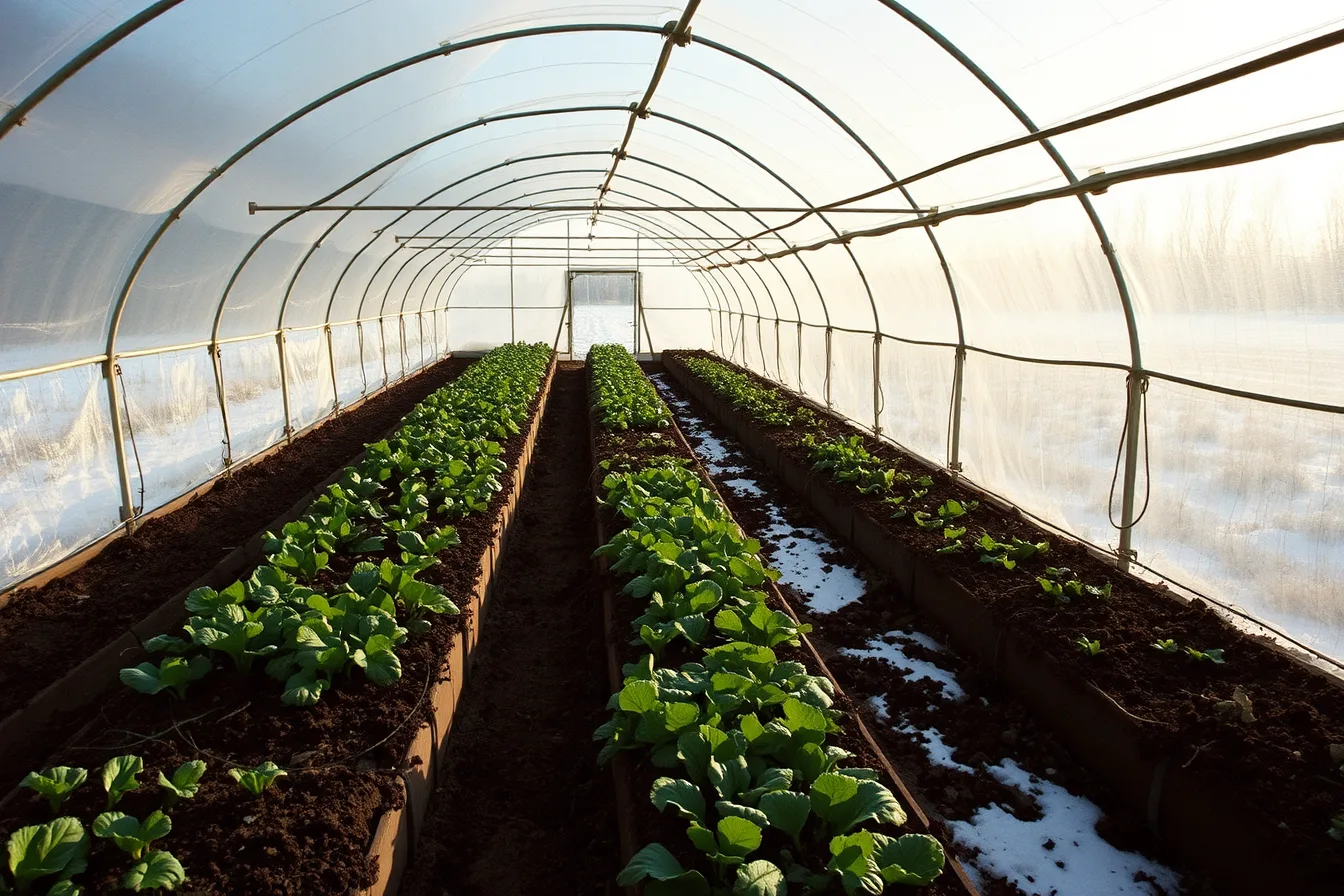
Greenhouse production and high tunnel production are not the same job in a Vermont or Madison winter. A greenhouse with heat can grow lettuce, spinach, herbs and microgreens through the coldest weeks. An unheated high tunnel protects crops but does not keep them actively growing once soil temperatures drop.
The practical split: use the high tunnel for extended fall harvest and early spring restart, and use heated greenhouse space for the high-value crops that justify the fuel or electricity bill. Baby greens, salad mix, herbs and microgreens carry a price that can cover heat.
Layer protection inside the structure. A high tunnel plus row cover plus a low tunnel can hold several degrees more than the tunnel alone. That difference decides whether spinach survives a Vermont cold snap.
Choose cold-hardy varieties deliberately. Winter spinach, mache, claytonia, kale and hardy lettuce types tolerate low light and cold soil better than summer varieties. Seed them on a schedule that targets December and February harvest windows.
Light is the limit in December and January. Supplemental lighting can help a greenhouse crop, but the electricity cost has to come out of the crop price. Run the numbers for your own structure before you promise winter greens.
Soil temperature matters as much as air temperature. Cold soil stalls growth even when the air is warm. Raised beds, soil heating cables and compost heat are common tools for keeping roots active.
Ventilation on a sunny winter day is easy to forget and expensive to skip. A closed tunnel can overheat at midday and then drop hard at night, which stresses plants more than steady cold.
Keep records of what each structure produced and what it cost to run. That record feeds the inventory and sourcing decisions you make the following season.
Indoor venue formats used by Vermont winter markets
Indoor venue tactics decide whether a winter market feels like a real market or a favor to shoppers. Vermont winter markets use granges, schools, churches, community halls and armories, plus a few purpose-built spaces. Each format changes how you set up and sell.
A grange hall usually means tight space, low ceilings and a single entrance. Vendors get a table and a wall. Signage has to work at eye level, and you cannot rely on a big display to draw people across a room.
A school gym or cafeteria offers more room and better parking. The tradeoff is a hard floor, bright overhead light and a layout that can scatter vendors. Ask the market manager where the traffic actually flows before you pick a spot.
Church and community halls often come with a kitchen. That matters if you sell prepared food, because a licensed kitchen changes what you can offer and what permit you need.
Some Vermont markets run on a winter-only schedule with a different manager and a different vendor list than the summer market. Read the winter rules separately. Fees, setup times and product limits can all differ.
Weather still governs attendance. A snowstorm on a Saturday morning cuts foot traffic even at an indoor market, because the drive is the obstacle. Vendors who build a pre-order or subscription channel survive those weeks better.
The USDA maintains a national farmers market directory that lists markets by state and season, which is the fastest way to find Vermont and Wisconsin winter markets before you apply.
The Dane County producers-only market model in Madison
Madison, Wisconsin is home to one of the largest producers-only markets in the United States, and the Dane County producers-only market model shapes winter selling across the region. The core rule is simple: a vendor may sell only what that vendor produced. Reselling is not allowed.
Producers-Only Compliance Records
- Keep planting records in one place
- Keep harvest logs current
- Keep storage notes with bin weights
- Expect farm visits or record requests
- Answer staff questions in minutes
That rule changes your winter plan in three ways. First, your product list is capped by your own production, so storage crops and greenhouse output become the whole table. Second, your pricing has to reflect your cost of production, because you cannot blend in a cheaper bought-in item.
Third, your reputation for authenticity is the asset, and shoppers at a producers-only market are checking.
Dane County has deep dairy and produce supply, and winter markets in the Madison area draw on that base. Cheese, butter, meat, eggs and storage vegetables all fit a producers-only winter table, and so do greenhouse greens.
Expect scrutiny. Market staff may visit your farm or ask for production records. Keep planting records, harvest logs and storage notes in one place so a question takes minutes, not a week.
Winter markets in Madison often run on a reduced schedule with a smaller vendor roster. That concentrates shopper attention, which rewards vendors with a full winter table and consistent attendance. It also means one empty booth is more visible.
The producers-only structure is a competitive advantage for a real grower. It keeps the market's identity clear, and it means a winter shopper who wants local food knows what the label means. ERS research on local foods and direct-to-consumer markets tracks how that consumer interest has developed.
Pricing and staffing a winter booth through the slow months
Winter pricing has to cover fixed costs that do not shrink with sales. Booth fee, insurance, transportation, heat or refrigeration, and your own time all continue in January. A summer price per pound rarely covers a winter market day.
Winter Booth Break-Even
- Add booth fee for the market day
- Add fuel to get there
- Add permit or license cost for the day
- Add labor hours including setup and teardown
- Divide by units you expect to sell
- Price above that floor for shrink
Start with a break-even calculation for a single winter market day. Add the booth fee, the fuel to get there, any permit or license cost allocated to that day, and the labor hours including setup and teardown. Divide by the units you expect to sell. That number is your floor.
Then price above the floor with room for shrink. Storage crops lose weight, greenhouse greens wilt, and unsold product at the end of a cold day is a real loss. A modest winter premium is normal and shoppers at a producers-only market generally accept it.
Bundling helps. A soup pack, a roasted root mix, a salad greens subscription. Bundles raise the average sale and move storage crops that are harder to sell one at a time.
Staffing should be lean and scheduled. Two people can run most winter booths: one on the table, one restocking and handling payment. Add a third only when a market day reliably exceeds what two can serve.
Use the slow weeks for work that pays later. Update your stock control checklist, repair equipment, plan spring planting, and talk to customers about what they want in March.
Cold-weather work has its own safety demands. Vendors standing outdoors for setup, loading or an outdoor winter market face cold stress and, on warm days, heat exposure. OSHA publishes guidance on working in outdoor and indoor heat and cold environments that covers the basics of dressing, hydration, breaks and recognizing symptoms.
A worked example makes the arithmetic concrete. Suppose a winter market day costs a $40 booth fee, $15 in fuel, $10 in allocated insurance and permit cost, and six labor hours at $20, which is $120. Total cost is $185.
If you expect to sell 100 units, your floor is $1.85 per unit. Price at $3.50 and a 60-unit day still covers cost with margin for shrink.
Winter is also when you decide next season's shape. Vendors who use the slow months to work through a farmers market vendor local seo checklist and plan an expansion and market guide for the following year enter spring with a schedule instead of a scramble.