Guides
The marketing plan for a farmers market vendor business for 2027
A 2027 farmers market marketing plan starts with your stall, your permits and your sell-through rate, not with ads. Here is what to do each week.
What to take away
- A 2027 marketing plan for a farmers market vendor business starts at the stall. Stall position, the market map and the vendor directory are reach you already pay for through booth fees.
- Pick one number to steer by each month. Sell-through rate, break-even units per market day and repeat-customer share all work. Clicks do not.
- Match every promotion to what your tent, cooler space and staffing can deliver on a Saturday morning.
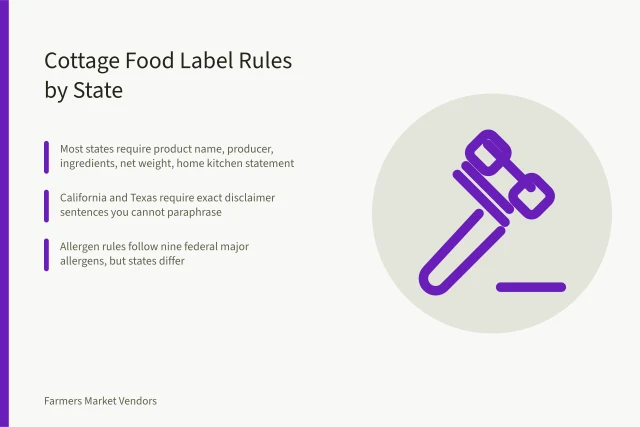
- Get the permit layer right before you print signage. Cottage food rules, weights-and-measures requirements and sampling rules come from your state and county, not a national standard.
- Ask for reviews and referrals in ways that survive FTC scrutiny. No gating, no incentives, no invented claims about your produce or your process.
- Name your tools in Januarya Square reader for cards, MarketLink for SNAP EBT, a free Google Business Profile and an updated USDA Local Food Market Directory listing.
This article covers farmers-market business in general. It is not food-safety, weights-and-measures, tax or legal advice for your jurisdiction.
Requirements vary by product and by market. Confirm them with your market manager, your state cottage food office, your local health department and a licensed professional.
Start with what the market already gives you
Most vendors treat the market as a place to sell and nothing more. It is also a directory, a map and a mailing list you already pay for through your stall fee.
Ask your market manager three things before you spend a dollar elsewhere. Where does your stall sit on the printed and digital market map? Does the market run a vendor directory or a weekly newsletter you can join? What does the market post about vendors, and how do you get included?
Two free directory listings reach shoppers who never walk past your tent. LocalHarvest at localharvest.org lets customers search farms and markets by ZIP code. The USDA Local Food Market Directory at foodmarkets.ams.usda.gov lists markets and direct-marketing farms by state.
Market managers want vendors who show up, sell well and bring customers back. A vendor who supplies a good photo and a two-line description makes the manager's job easier. That vendor tends to get the better stall next season.
The Farmers Market Coalition, a nonprofit market association, publishes free resources for vendors and market operators at farmersmarketcoalition.org. Its metric guides are a common starting point for market-level reporting.
Know your permit layer before you market anything
Marketing a product you are not cleared to sell is the most expensive mistake in this business. The rules that govern you come from three places, and they do not always agree.
Permit layers for vendors
Layer
- Cottage food
- State statute
- Food safety
- County health dept
- Weights and measures
- State agriculture dept
- Market rules
- Vendor agreement
- Liability insurance
- Market or insurer
Who sets it
- Cottage food
- Home foods, labeling, caps
- Food safety
- Sampling, handling, certification
- Weights and measures
- Scales, labels, net weight
- Market rules
- Stall setup, signage, insurance
- Liability insurance
- Certificate, product liability
What it covers
- Cottage food
- Food safety
- Weights and measures
- Market rules
- Liability insurance
Know your permit layer
| Layer | Who sets it | What it typically covers |
|---|---|---|
| Cottage food | Your state's cottage food statute | Which low-risk foods you may make at home, labeling, and any sales cap |
| Food safety | Your county or city health department | Sampling, handling, temperature control, and any required handler certification |
| Weights and measures | Your state agriculture department | Scales, packaged-goods labeling, and net-weight accuracy |
| Market rules | Your market's vendor agreement | Stall setup, signage, sampling, and insurance certificates |
| Liability insurance | Your market or your insurer | Certificate of insurance, additional-insured wording, and product liability |
Your market manager can tell you which of these apply at that specific market, because some markets add their own rules on top.
If you sell value-added goods, ask the manager and the health department in writing before you build a menu around them.
ServSafe or your state's equivalent course is the usual starting point for handler certification. Confirm which certificate your county accepts before you pay for a class.
Two federal handbooks sit behind most of the paperwork. NIST Handbook 44 covers scales and other weighing devices. NIST Handbook 130 covers packaged-goods labeling and net-weight accuracy.
The Institute for Justice publishes a state-by-state cottage food law map at ij.org. It tracks which foods are allowed at home, what the label must say and whether your state caps annual sales.
Name your customer and your price basis
Write one sentence: who buys from you, at which market, and why they pick you over the stall two rows over. "People who like good food" is not a customer. "Saturday shoppers at a suburban market who buy raw honey for gifts" is.
Then write your price basis. For produce, that is usually price per pound or per bunch against what the grocery store charges for the same item. For value-added goods, it is ingredient cost plus labor hours plus packaging, divided by the units you actually sell.
Underpricing value-added goods is the standard failure. A jam priced at ingredient cost alone pays you nothing for the afternoon you spent making it. Work the arithmetic with your own numbers before you set the sign.
Typical market prices give you a sanity check, not a rule. In most markets a half-pint of fruit jam sells for $8 to $12, while the jar, lid and label typically run $1 to $1.50. Anything below that band usually means the label is subsidizing the customer.
Build the stall so it sells without you talking
A farmers market stall is a display problem before it is a marketing problem. Customers decide in a few seconds whether to stop, and they decide from the edge of the aisle.
Build the stall so it sells
- Heightget product off the table surface so it reads from ten feet away. Crates, risers and a tiered table do this.
- Signageone price sign per item, large enough to read without leaning in. Handwritten is fine; unclear is not.
- Cold chaincoolers and ice for anything that needs it, checked at set-up and again at midday.
- Samplingonly where your health department allows it, with the handling rules it requires.
- Paymenta card reader with a backup, plus a cash float you can make change from at 7 a.m.
Square lists its contactless reader at $49, with card-present processing at 2.6% plus 10 cents as of 2026. Buy the backup reader before your first market, not after a dead battery.
Vistaprint banners typically run $20 to $40 for a 2-by-4-foot custom sign. A dry-erase price board costs less and lets you change prices by the week.
Photograph the stall once it is set up well. That photo is your listing image, your social post and your proof for next season's application.
Run the market day as a measured operation
Pick one number to steer by and write it down after every market. Sell-through rate is the simplest: units sold divided by units brought. If you bring 40 heads of lettuce and sell 26, that is 65%.
Break-even units per market day is the second number. Add your stall fee, your mileage, your packaging and your spoilage, then divide by your average margin per unit. That tells you how many units you must sell before the day pays you anything.
Mileage goes at the IRS standard rate, 70 cents a mile for 2025, and the agency resets the figure each December. Check the 2027 number before you build the year's budget.
Track both numbers for a full season before you change your product mix. Vendors who overstock perishables usually do it because they never wrote down what they threw away.
A free Google Sheets spreadsheet holds the log. Square's dashboard gives you card totals by day, and a paper notebook covers cash and spoilage.
Ask for reviews and referrals the way the FTC requires
The Federal Trade Commission's guide for marketers on soliciting and paying for online reviews sets the standard here.
Ask everyone, not just the customers you expect to praise you. Do not offer a discount for a review, and do not have staff write them.
The FTC's advertising FAQs for small business cover the other half. Any claim you make about your produce, your growing method or your ingredients has to be true and supported. "Organic" is a regulated term, not a compliment.
Referrals work the same way. A coffee roaster two stalls down who sends customers to you should know what you sell, what you do not, and how you will send people back. Say out loud whether money changes hands, and put it in writing if it does.
Google Business Profile and Yelp listings are free. A shopper who searches your farm name should find your market days, your hours and a photo before they find a competitor.
Worked example: a Saturday market day
A vendor sells bread and jam at one Saturday market. Stall fee is $45. Round-trip mileage is 30 miles at the current IRS standard rate. Packaging runs about $0.40 per unit.
She brings 60 loaves and 40 jars. By 1 p.m. she has sold 48 loaves at $8 and 22 jars at $9. Sell-through is 80% on bread and 55% on jam. The jam is the number to watch.
Her break-even for the day is her fixed costs divided by her average margin per unit. With $45 in fees, roughly $20 in mileage and about $40 in packaging, she needs to clear $105 before the day pays her anything.
She cleared it by mid-morning, which means the afternoon was profit, not survival. She knew those numbers before she packed the van, and that is the part worth copying.
Your 2027 calendar, January to December
The work runs on the market calendar, not the advertising calendar. Most of it happens before the season opens and again in November, when next year's applications go out.
Your 2027 calendar
- Confirm your permit status in writing with your state cottage food office and your county health department, and confirm your market's own rules with the manager.
- Photograph your stall at its best and send the photo and a two-line description to every market manager you sell with.
- Write your one-sentence customer definition and your price basis, then check them against your last three market days.
- Start a weekly logunits brought, units sold, cash taken, card taken and spoilage. Add one note about what customers asked for.
- Ask every customer for a review for one month, with no incentive and no gating, and see what changes.
| Month | Action | Tool or number |
|---|---|---|
| February | Set the year's sell-through target and log last season's spoilage | Google Sheets, market day log |
| March | Update your USDA Local Food Market Directory entry and claim your Google Business Profile | Free listings |
| April | Order signage and a backup card reader | Vistaprint, Square |
| May | Add preorders if your market allows them | WhatsGood or Local Line, both subscription based |
| June | Print a schedule card and hand it out with every sale | Local print shop |
| July | Set up cross-referrals with two vendors and write down the terms | Written agreement |
| August | Recheck sampling rules before peak tomato and peach season | County health department |
| September | Enroll in SNAP and produce-incentive programs if you accept them | MarketLink, Double Up Food Bucks |
| October | Run the season numbers: sell-through, repeat share, break-even units | Weekly log, Square dashboard |
| November | Apply to next season's markets with photos and your sell-through figure | Market applications |
| December | Adjust prices by the numbers and set the 2028 target | Price basis worksheet |
Common questions
Do I need a website to market a farmers market stall?
No, but you need one place customers can find your market schedule and your contact details. A single page with your dates, your markets and a photo is enough to start.
A free Google Business Profile covers local searches at no cost. Keep the schedule current, because a stale one is worse than none.
How do I handle SNAP and FMNP tokens?
Rules and equipment vary by state and by market, so ask your market manager how that market runs its token program and what you need to accept them.
MarketLink, funded by USDA and run through the National Association of Farmers Market Nutrition Programs, supplies SNAP EBT equipment and support to markets and direct-marketing farms. Do not assume your neighbor's setup applies to you. Get the current process in writing before your first token transaction.
FMNP coupons come through your state's WIC and senior nutrition agencies, and each state runs its own authorization steps. Confirm those steps with your market manager before the season starts.
What should I do about a competitor at the same market?
Differentiate on something a customer can check: a variety nobody else grows, a preparation method, or a level of ripeness at sale.
Competing on price against a stall selling the same item usually ends with both of you underpricing. If the market is genuinely saturated, ask the manager how vendor categories are balanced.
How do I know if a marketing spend was worth it?
Pick one measure before you spend and compare it after. For a market vendor, repeat-customer share and sell-through rate move faster than web traffic.
If a paid promotion does not change either number, stop it and put the money into packaging or a better sign.