Guides
Farmers market vendor equipment brands compared for 2027
TentCraft, Eurmax, Cambro, YETI and Square compared on wind rating, cold retention, produce scale accuracy and card processing fees for vendors in 2027.
What to take away
- Buy the tent for the wind rating on the frame, not the color. Farmers market vendor equipment brands are judged on that number: a 10x10 pop-up that folds in a gust costs you a market day and a repair.
- Cold chain is a capacity decision. Cambro and Igloo hold temperature; YETI holds it longer per dollar spent up front.
- Legal-for-trade scales from CAS, Detecto and Avery Berkel print a receipt a weights-and-measures inspector will accept. A kitchen scale will not.
- Square and Clover differ mainly in card fees and offline behavior, not in the register screen.
- Write the arithmetic in your own numbersunits sold per market day times margin per unit, minus stall fee, minus mileage.
Start with the wind rating, not the color
Every vendor buys the tent first and thinks about wind second. Reverse that.
Four canopy brands cover most farmers market stalls: TentCraft, Eurmax, UnderCover and Coleman.
TentCraft builds commercial canopies with published wind ratings and replacement parts you can order by name. A 10x10 with sidewalls typically runs $600 to $1,600, and the aluminum frame carries a limited warranty.
Eurmax sells the same footprint at a lower price with lighter frames, which suits a Saturday-only vendor who packs down at the first dark cloud. An Eurmax 10x10 typically sells for $150 to $500.
UnderCover sits between them on price and frame weight. Coleman covers the occasional-market vendor who needs a shelter twice a season, and its 10x10 instant canopy typically sells for $120 to $250 at big-box stores.
The number that matters is the frame's wind rating, printed on the box. Consumer pop-ups without a published rating typically handle gusts near 20 to 30 mph. Commercial frames that do publish one commonly claim 40 mph and above when anchored.
A market manager who closes the field at a gust threshold will send you home either way. The difference is whether the frame survives the trip.
Two anchors matter as much as the canopy: weight plates, because a stake will not bite asphalt, and a sidewall, because rain arrives sideways. A set of four 25-pound plates typically costs $40 to $120, and a sidewall $60 to $150.
Read the farmers market vendor equipment and setup guide for 2027 before you order a canopy in a size your stall does not allow.
Cold chain: what each brand actually holds
Coolers and food pans are where the money hides, because spoilage is invisible until the end of the day.
What it is
- Cambro
- Commercial food pans, Camtainers, insulated carriers
- Igloo
- Consumer and light commercial coolers
- YETI
- Rotomolded coolers with long ice retention
- Rubbermaid Commercial
- Bus tubs, bins, shelving, carts
Suits
- Cambro
- Prepared and value-added food
- Igloo
- Produce, drinks, short days
- YETI
- Meat, dairy, all-day markets
- Rubbermaid Commercial
- Storage and transport between markets
Pricing model
- Cambro
- Per-unit dealer pricing; Camtainers typically $250 to $350, food pans $15 to $40 each
- Igloo
- Retail, widely discounted; 100-quart models typically $80 to $150
- YETI
- Premium retail, no distributor tier; Tundra 45 lists near $325, Tundra 65 near $400
- Rubbermaid Commercial
- Per-unit commercial catalog; bus tubs $15 to $30, Brute bins $40 to $120
Cambro pans are sized to fit standard steam tables and reach-in shelves, which is why caterers and market food vendors both use them.
Igloo gets you through a four-hour market. A rotomolded YETI holds ice through a double market day in July, and it costs more per quart.
Insulation thickness drives that gap. YETI's Tundra line quotes about two inches of it; a standard Igloo cooler uses roughly half as much.
Rubbermaid Commercial is the unglamorous one: bins that stack in a van, carts that roll over gravel. Buy the transport before the display.
Scales and payment: the two places inspectors and fees find you
A scale used to price a sale is a legal-for-trade instrument in most states. CAS, Detecto and Avery Berkel all sell counter scales and label-printing scales built for retail.
Confirm the model carries the approval your state weights-and-measures office requires, and confirm who performs the seal.
Federal rules set the accuracy floor through NIST Handbook 44. A retail scale should carry an NTEP certificate and a Class III rating, and that certificate names the models approved for commerce.
A price-computing counter scale from CAS or Detecto typically costs $150 to $400. Avery Berkel label-printing scales, which add a thermal printer for priced labels, typically run $1,500 to $4,000.
Your local health department and state weights-and-measures office set those rules, not this article.
Square and Clover both run card payments, a register, and inventory. Square's model is a flat rate per swipe with no monthly fee on the basic tier.
Square's published in-person rate is 2.6% plus 10 cents, and keyed entries cost 3.5% plus 15 cents. A Square Reader costs $49, a Square Terminal $299, and a Square Register $799.
Clover sells hardware through merchant-service resellers, so the rate depends on the reseller's contract. Hardware runs from about $50 for a mobile reader to $1,800 for a countertop station, and many resellers add a monthly fee.
Ask both for the effective rate on your average ticket, not the headline rate.
Offline mode decides the rainy market. Test it before you need it.
Where the permits and the safety file live
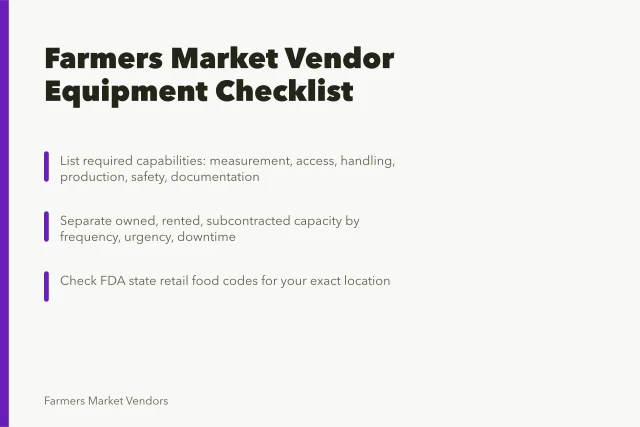
Your stall layout, food handling and equipment cleaning have to satisfy the authority that inspects you. The FDA state retail and food service codes directory lists which agency handles retail food in your state. Start there, then call the market manager.
If you employ anyone, OSHA's safety management guidance describes a hazard-finding program: propane storage, generator placement, lifting, and the tent frame that comes down in wind. Keep the written record. It is the evidence an inspector asks for.
The USDA local food directories list markets by state, but each market's current eligibility, insurance and product rules come from the market itself.
New owners usually undercount the permit and inspection layer. The equipment checklist for new owners walks the sequence.
Run the numbers before you buy the brand
Write the arithmetic in your own variables:
- Units sold per market day, times margin per unit, equals gross margin per day.
- Subtract stall fee, mileage at the IRS rate, and spoilage.
- Divide the equipment price by the result. That is your payback in market days.
Stall fees in most markets run about $20 to $100 per market day, and a seasonal food permit typically costs $100 to $500.
A $900 cooler that saves two cases of meat a season may pay back faster than a $300 one that does not. That depends on your product, not the brand.
Buying used changes the payback and the warranty. The new versus used equipment cost comparison covers what you give up.
Common questions
Which tent brand should a first-year vendor buy?
Eurmax if you sell one day a week and pack down early, at a typical $150 to $500. TentCraft if you sell three days a week or face open field wind, at a typical $600 to $1,600. Check your market's stall size and stake rules before ordering either.
Is a YETI cooler worth it over an Igloo?
Only if you sell meat, dairy or prepared food across a full day. Compare ice retention per dollar against your spoilage cost per market day: a Tundra 45 lists near $325, a 100-quart Igloo near $100. For produce on a four-hour market, Igloo is enough.
Do I need a legal-for-trade scale?
If you price anything by weight, most states require one. CAS, Detecto and Avery Berkel all sell approved models, typically $150 to $400 for a counter scale. Confirm the required approval and who seals it with your state weights-and-measures office.
Square or Clover for a market stall?
Square for a simple flat rate and no monthly fee on the basic tier, at 2.6% plus 10 cents in person. Clover if your reseller bundles hardware and support you want. Ask each for the effective rate on your average ticket, then test offline mode.