Guides
Farmers market vendors under review: the good, the weak and the verdict
Farmers market vendors get a close review that names real farms and specific food stalls and shows what to check before you copy any vendor model.
What to take away
- A vendor worth studying sells your product type, at your scale, at a market you can drive to on a Saturday.
- The verdicts below sort named companies into copy, study logistics only, and skip. Fewer than half fit a single stall.
- Typical copy costs run $15 to $75 for a booth day, $10 to $30 for a food handler card, and $25 to $50 an hour for a shared kitchen.
- Three weekly numbers settle the verdictbreak-even per market day, margin by SKU, sell-through rate. Verify the current channel before you copy anything.
How the verdicts are set
Three questions filter a list fast. Same product type? Same scale? Same market size? A 400-acre greenhouse grower tells a Saturday stall nothing about tent layout or cold chain.
Filter Vendors by Fit
Same size as your operation?
study its decisions
skip this vendor
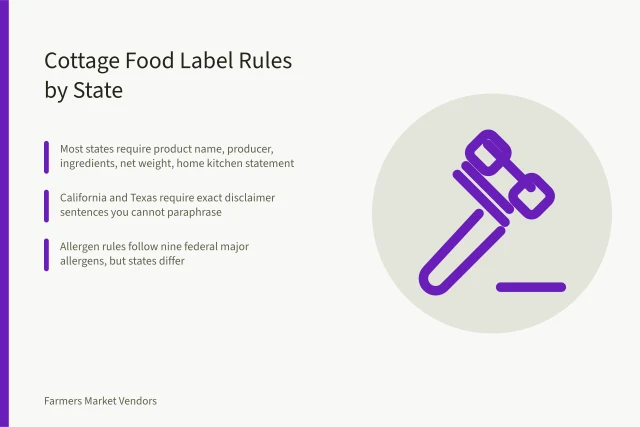
The fourth question most reviews skip is the permit. Cottage food rules, commercial kitchen requirements and weights-and-measures labeling differ by state and by product. The farmers market vendor license requirements brief walks through permits, labels and inspection before you lock in a product line.
Every company gets one verdict: copy, study logistics only, or skip. Copy means the model fits a stall or a small licensed kitchen. Study logistics only means the volume or the cold chain sits beyond your first year, and skip means the capital or the channel is a different business.
The shortlist and its verdicts
| Vendor | Base and model | Verdict |
|---|---|---|
| Rancho Gordo | Napa, California. Heirloom beans, direct and mail order. | Copy the dry-goods model |
| Mike's Hot Honey | Brooklyn, New York. One hero SKU, infused honey. | Copy the single-SKU focus |
| Jacobsen Salt Co. | Portland, Oregon. Single-ingredient finishing salt. | Copy if you sell one ingredient |
| Beecher's Handmade Cheese | Pike Place Market, Seattle. Cheese and a retail counter. | Copy if you sell year round |
| Stonewall Kitchen | York, Maine. Jams and sauces, cottage to retail. | Study the jar and label path |
| Organic Valley | Farmer-owned dairy cooperative. | Study logistics only |
| Pete & Gerry's Organics | New Hampshire organic eggs, regional. | Study cold chain only |
| Driscoll's | Watsonville, California. Berries at wholesale scale. | Skip, the scale is not copyable |
None of these sell from a stall today, and that is the honest limit of any name list. Use the verdicts as categories, then find the local equivalents near you. Profiles reflect published company information for the current season, and channels, ownership and packaging change. Verify before you copy.
What each model costs you to copy
Typical ranges, not quotes:
| Cost line | Typical range | What drives it |
|---|---|---|
| Booth fee, 10 by 10 stall | $15 to $75 per market day | Urban and premium markets run higher |
| Food handler card | $10 to $30 | One-time, renewal rules vary |
| Cottage food registration | $0 to $100 | State dependent, often free |
| Shared commercial kitchen | $25 to $50 per hour | Monthly minimum hours common |
| Product liability insurance | $400 to $1,200 a year | Sales volume and product type |
| Ice and cold chain | $5 to $20 per market day | Eggs, dairy, meat, cut greens |
A co-op like Organic Valley trades margin for shared processing and a buyer who takes volume. Direct sales keep the margin and keep the Saturday.
Value-added goods carry the permit question first. Jams, sauces, cheese and tinned fish may fall under cottage food limits or require a licensed kitchen, and the rent lands in your break-even before the first jar sells.
Cold chain decides which models you can even attempt. Eggs, dairy and meat need refrigeration from load-in to close, so coolers and ice become a cost line rather than a product line. The farmers market vendor equipment checklist for new owners covers the coolers, tables and power a first season really needs.
Tinned fish and low-acid canned goods usually need a scheduled process at a licensed facility with a tested recipe. Treat that as a skip until you have a co-packer.
The three numbers that produce a verdict
- Break-even per market day. Add booth fee, mileage, ice, labels, insurance share and your own hours. Divide by average margin per unit. That is the unit count the day must move before it pays, so write it on the clipboard.
- Margin by SKU. Some items sell fast and earn little. Some sell slowly and earn well. Track both, then assign shelf space by margin rather than by popularity.
- Sell-through rate. Units sold divided by units brought. A low rate on perishables is spoilage you already paid for.
Three Weekly Checks
- Break-even per market daybooth fee, mileage, ice, labels, hours
- Margin by SKUshelf space by margin, not popularity
- Sell-through rateunits sold divided by units brought
Keep all three weekly, not yearly, because weekly books show a bad month while you can still change the next market. The pricing a farmers market vendor business for profit guide turns those three numbers into a price you can defend at the table.
Where the rules come from
The USDA Local Food Directories: Farmers Markets lists markets by state from information market managers submit. Use it to find markets near you, then confirm eligibility, application, product limits, insurance and stall prices with each manager.
Sales tax rules differ by state. The IRS directory of state government websites is the fastest route to your state revenue department and its vendor requirements.
If you want to accept SNAP benefits, the USDA SNAP retailer application explains eligibility for markets and for individual vendors. Ask your manager whether the market holds one authorization or whether each vendor applies alone.
Market managers usually ask for a certificate of insurance before your first Saturday. The farmers market vendor insurance costs and coverage review sets out typical premiums and the gaps that catch new stalls.
Confirm cottage food limits with your state cottage food office, and food safety questions with your local health department. Those two calls decide your product list.