Guides
What US vendors can learn from Canadian farmers market regulations
US farmers market vendors can learn from Canadian provincial food safety rules and vendor support programs to close gaps in state rules and border labeling.
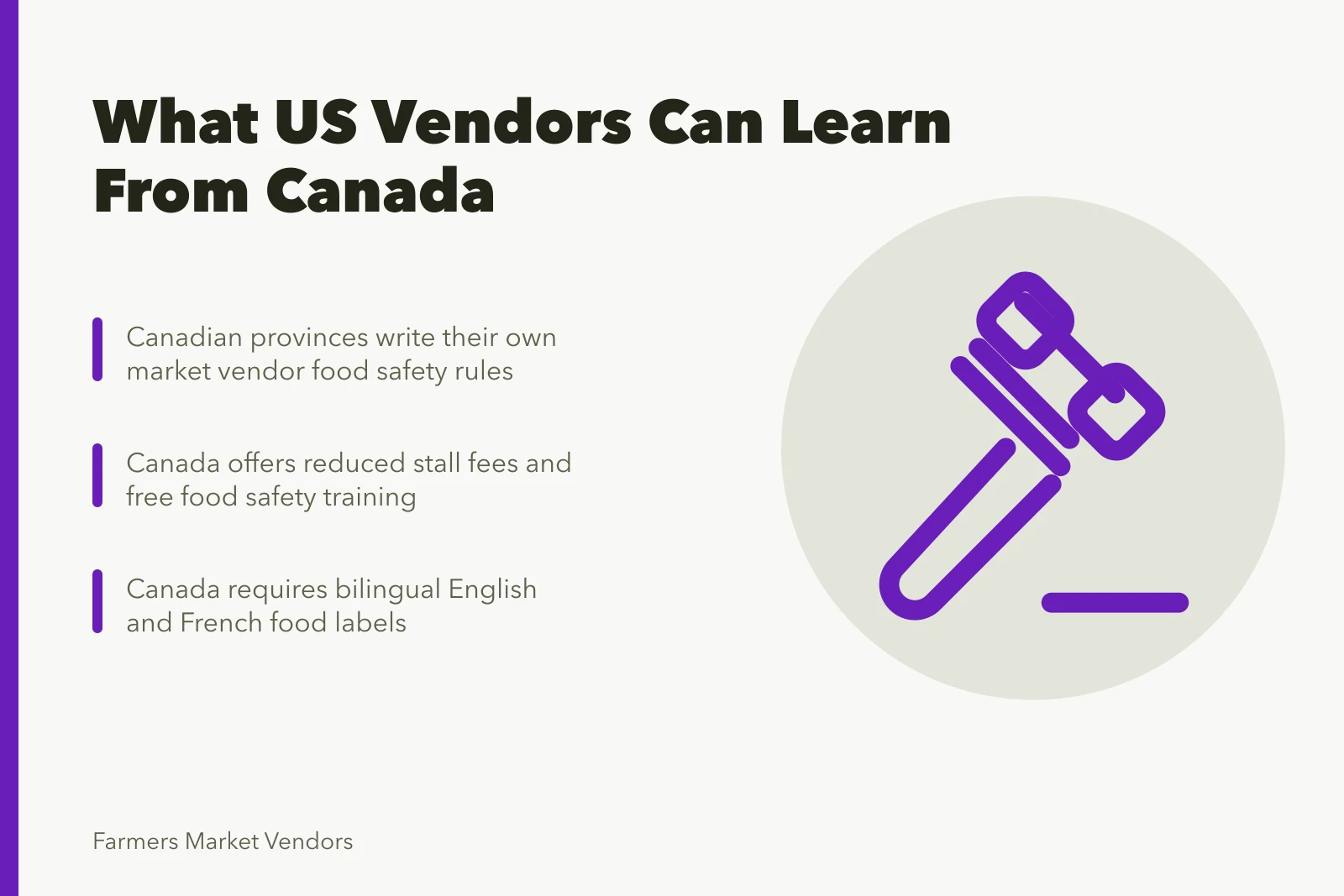
What to take away
- Provincial rules treat market vending as its own category. Ontario's Food Premises Regulation (O. Reg. 493/17) and BC's Food Premises Regulation apply to stalls, and health authorities publish market guides.
- Most US states never write that category. Vendors juggle cottage food statutes, county permits and temporary event rules to find what applies to a stall.
- Canada pairs rules with supportlower first-season stall fees, mentor matches and hourly licensed kitchen space.
- Canadian bilingual and allergen labelling means a cross-border seller needs two label designs and two record sets.
- Market associations can borrow a two-page stallholder guide, a yearly market-specific training session and a mentor match.
Provincial rules name the stall; most US state rules do not
Ontario's Food Premises Regulation (O. Reg. 493/17) applies to temporary food stalls. British Columbia's Food Premises Regulation works the same way, with Fraser Health and Vancouver Coastal Health publishing farmers market guidelines. Alberta ties its Approved Farmers' Market designation to provincial rules.
Most US states never create that category. A vendor reads a cottage food statute, a county permit and a temporary event rule, then works out which covers sampling at a Saturday stall. Our guide to US cottage food laws shows how one of those layers decides what a home kitchen may sell.
The FDA Food Code is a model, not a federal statute. Food Code 2022 is the most recent published edition, and each state adopts an edition on its own schedule.
Provincial rules name the stall
Canadian provincial practice
- Market vendor category
- Defined in regulation or health authority guidance
- Handwashing at the stall
- Guides name potable water, soap, paper towels, waste container
- Sampling
- Written into provincial market guides
- Training
- Food handler certificate, sometimes with a market module
- Inspection
- Provincial schedule, often annual for markets
US state practice
- Market vendor category
- Rarely separate; folded into cottage food or event rules
- Handwashing at the stall
- Required in general terms; details vary by county
- Sampling
- State or county specific, often unclear
- Training
- Certificate may not cover markets
- Inspection
- County schedule set by staffing and risk
Canada vs US Market Rules
Canada
- Rule source
- Provincial
- Market guidance
- One document
- Food handler cert
- Market module
- Rule updates
- More frequent
- Temperature control
- Thermometer required
United States
- Rule source
- State adoption
- Market guidance
- Separate documents
- Food handler cert
- May lack market focus
- Rule updates
- Varies by state
- Temperature control
- Not always specified
Hand the county health department this table. A rule that names the stall is easier to follow than one written for a restaurant kitchen.
Support programs ride along with the rules
Canadian market programs commonly discount first-season stall fees, match newcomers with experienced vendors and rent licensed community kitchens by the hour. The pattern repeats across provinces.
US markets rarely bundle those supports. Full fees start on week one, shared kitchens sit outside market programs, and mentoring happens by accident.
Our compliance checklist for new owners lists the permits and certificates a US vendor must hold, which is the paperwork a mentor would otherwise walk through in person.
Funding is the usual blocker for market associations. The Farmers Market Promotion Program pays for training, outreach and market development.
Labelling and inspection differ at the border
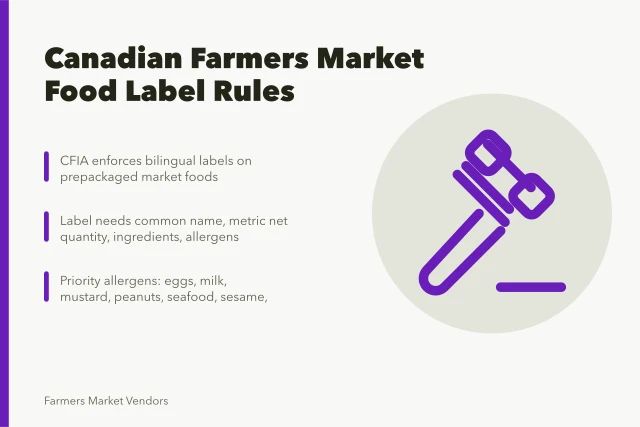
Canada requires bilingual English and French labelling on most prepackaged foods, plus allergen statements written in everyday words. US labels follow FDA format with named allergens. Health Canada food labelling sets out what a Canadian vendor works from.
Cross-Border Labeling Rules
Canada
- Language
- Bilingual English/French
- Allergen format
- Everyday words
- Nutrition facts
- Canadian rules
- Inspection frequency
- May be more often
United States
- Language
- English only
- Allergen format
- Set allergen names
- Nutrition facts
- FDA rules
- Inspection frequency
- Varies by county
Inspection timing diverges too. Provincial inspectors often follow a fixed market calendar. US inspection depends on county staffing and vendor risk level, so selling in three counties can mean three rhythms.
Example: one jar, two label designs
Take a salsa sold in Ontario and in New York. Ontario wants a bilingual label and a full allergen statement. New York wants a US nutrition panel and named allergens.
One recipe, two print runs, two sets of batch records. A seller who plans this in January avoids reprinting in July. The legal and insurance guide covers the records and coverage each side expects.
Two pages a market association could write
- Stall setuphandwash station with potable water, soap, paper towels and a waste container; probe thermometer on site.
- Samplingsingle-serve portions, covered containers, no bare-hand contact, no re-serving leftovers.
- Labelsproduct name, ingredients, allergens, net weight, business name and address.
- Recordscold storage log, food handler certificates, permit numbers.
- Escalationthe county contact to call when a rule is unclear.
A guide that fits on two pages gets read at the stall. A long code does not.
What US market associations can borrow
- Publish the two-page stallholder guide and hand it out with the stall contract.
- Run one market-specific food safety session a year with the county health department.
- Fund a first-season fee subsidy and a mentor match from dues, sponsors or grants.
- Ask the state to adopt the guide as a market addendum to its current Food Code edition.
- Track Federal Register notices and state agriculture bulletins, then alert members.
SNAP and EBT paperwork shows why support matters more than rules alone. The guide to SNAP and WIC FMNP compliance covers the training and reporting that land on the vendor, work an association can centralize.