Guides
What farmers market vendor software should measure for 2027
Farmers market vendor software should track sell-through, margin by SKU, booth cost per market day, card fees and cash, not features you never open.
What to take away
- Software earns its place when it answers one questiondid this market day make money after the booth fee, the tent, the mileage and the spoilage.
- Sell-through rate, margin by SKU and break-even per market day are the three numbers a vendor can act on the same week.
- Sell-through rate: how much to bring next Saturday.
- Margin by SKU: what to reprice or drop.
- Break-even per market day: the sales target the day has to clear.
- Cottage food rules, commercial kitchen rules, SNAP and WIC FMNP token handling, and permit layers differ by state and market. Confirm each with your state cottage food office, your local health department and the market manager.
- Cash-flow books kept weekly beat a year-end shoebox. IRS Schedule C wants records that clearly show income and expenses.
- Test any system on a real Saturdayone tent, one card reader, one scale, one set of labels.
This article covers general farmers-market business practice. It is not food-safety, agricultural, labeling, or weights-and-measures advice. It is not tax, licensing, insurance, or legal advice. Requirements vary by product, preparation method, market and jurisdiction. Confirm current rules with your market manager and the responsible authority.
What a market day actually costs
A market day is a small business with a fixed cost and a variable return.
Break-even math for a market day
- 60%gross margin
- $180fixed cost
- $300break-even sales
Let F be the booth fee, M the round-trip mileage cost, I the daily share of your insurance rider, S the value of stock that will not survive the day, and C the card and token processing fees.
Your break-even revenue is (F + M + I + S + C) divided by your gross margin as a decimal.
A vendor at a 60 percent margin with 180 dollars of fixed cost needs 300 dollars in sales before keeping a cent.
That figure is not a benchmark. It is your own arithmetic, and it changes when the market raises its fee or when you add a second tent.
The three numbers worth tracking weekly
Sell-through rate is units sold divided by units brought. A grower who brings 200 bunches of greens and sells 140 has a 70 percent sell-through. The other 60 bunches were harvested, cooled, hauled and then composted. Sell-through tells you whether to bring more next Saturday or plant less.
Sell-through example: greens
- 200bunches brought
- 140bunches sold
- 70%sell-through
- 60bunches composted
Margin by SKU is price minus the cost of that item, divided by price. Value-added goods carry ingredient, jar, label and kitchen time. These goods include jams, breads and soaps. Underpricing them is the most common failure in the category, because the maker counts ingredients and forgets the hours.
Cash-flow books kept weekly are the third. Money collected at the booth is not profit; it is cash that still owes the booth fee, the processor and the next batch of jars. IRS Schedule C asks for records that clearly show income and expenses, and the IRS recordkeeping guidance is the plainest statement of what that means.
Booth fees, stall sizing and market saturation
Booth fees are set by the market, not by you, and they vary widely between a rural Saturday market and a city greenmarket. Ask the market manager for the current fee schedule, the stall dimensions, whether electricity is included, and whether the fee is per day, per season or per stall frontage.
Stall sizing decides what you can display and what you can store behind you. A ten-by-ten stall with a tent, two tables and a cooler leaves little room for a queue. If card and token customers form a line, the line blocks the table and costs you sales.
Market saturation is the quiet risk. Two honey vendors at a forty-stall market split the honey demand. Before applying, walk the market on a normal Saturday and count vendors selling what you sell.
The USDA farmers market directory lists markets by state and is built from information market managers submit, so it is a starting list, not a verified one.
Confirm eligibility, application, product and insurance rules directly with each market.
Permits, cottage food and token handling
Permit layers stack. A market may require its own vendor application, your local health department may require a food handler card or a permit, and your state may require a cottage food registration for shelf-stable goods made at home.
Cottage food vs. commercial kitchen is the line that decides where you may produce. Most cottage food statutes cover non-hazardous, shelf-stable items and cap annual sales, and those caps and categories differ by state. Your state cottage food office publishes the current list. Anything requiring refrigeration, or containing meat or dairy, usually needs a licensed commercial kitchen.
SNAP and WIC FMNP tokens are their own workflow. Eligible vendors are authorized, tokens are issued and redeemed on a schedule, and the market or the state agency reconciles them. Ask the market manager who authorizes vendors, what the redemption window is, and how the tokens settle into your account.
Food-safety and handling practice belongs to your local health department and to a certified food handler course such as ServSafe or the equivalent your jurisdiction accepts. Labeling and allergen statements follow FDA rules and your state; a qualified professional can confirm what your product requires.
Choosing software: what to test on a real Saturday
What changes for 2027 is the version of the rules you work under. Fee schedules, cottage food caps and SNAP and WIC FMNP token procedures are revised on their own cycles, so confirm the current text with your market and your state agency before the season opens.
Test any system the way you work: one tent, one card reader, one scale, one label printer, one person at the table. Run a full market day in the software before you commit to a season.
A short checklist for the test day:
Software test-day checklist
- Ring cash, card and token sale
- Reconcile all three against drawer
- Sell one item by weight and count
- Record spoilage write-off
- Export sales and open in spreadsheet
- Confirm system works when signal drops
What to test on a real Saturday
- Record one cash sale with the phone in airplane mode, then turn the signal back on and confirm that the sale syncs.
- Run one SNAP or WIC FMNP token redemption and match your total against the market reconciliation sheet.
- Export the day as a CSV file and check that every line carries item, quantity, price and payment type.
- Weigh one item, print the label from the software, and compare the printed weight and price with the scale.
- Count the cash drawer at close and compare your count with the software cash total.
- Sign in as a second user and confirm that both logins show the same day totals.
The same criteria apply to any candidate tool.
What the software must measure
| What the software must measure | How you verify it on the test day |
|---|---|
| Sell-through by item | units sold divided by units brought, per item |
| Margin by SKU | price minus item cost, divided by price |
| Break-even per market day | the day's fixed cost divided by gross margin |
| Offline sales | a sale taken with no signal appears once the device reconnects |
| Token reconciliation | SNAP and WIC FMNP totals match the market sheet |
| Export | a CSV that lists item, quantity, price and payment type |
| Permissions | each staff login sees only what the role needs |
If the export needs cleanup, the system will cost you an evening every week. The best farmers market vendor software for 2027 comparison covers what each option handles at the booth, including offline sales and token reconciliation.
Security and record hygiene at the booth
Booth staff share a card reader and a phone, which is exactly where shared logins appear. Give each person their own account, keep permissions to what the role needs, and remove access the week someone leaves.
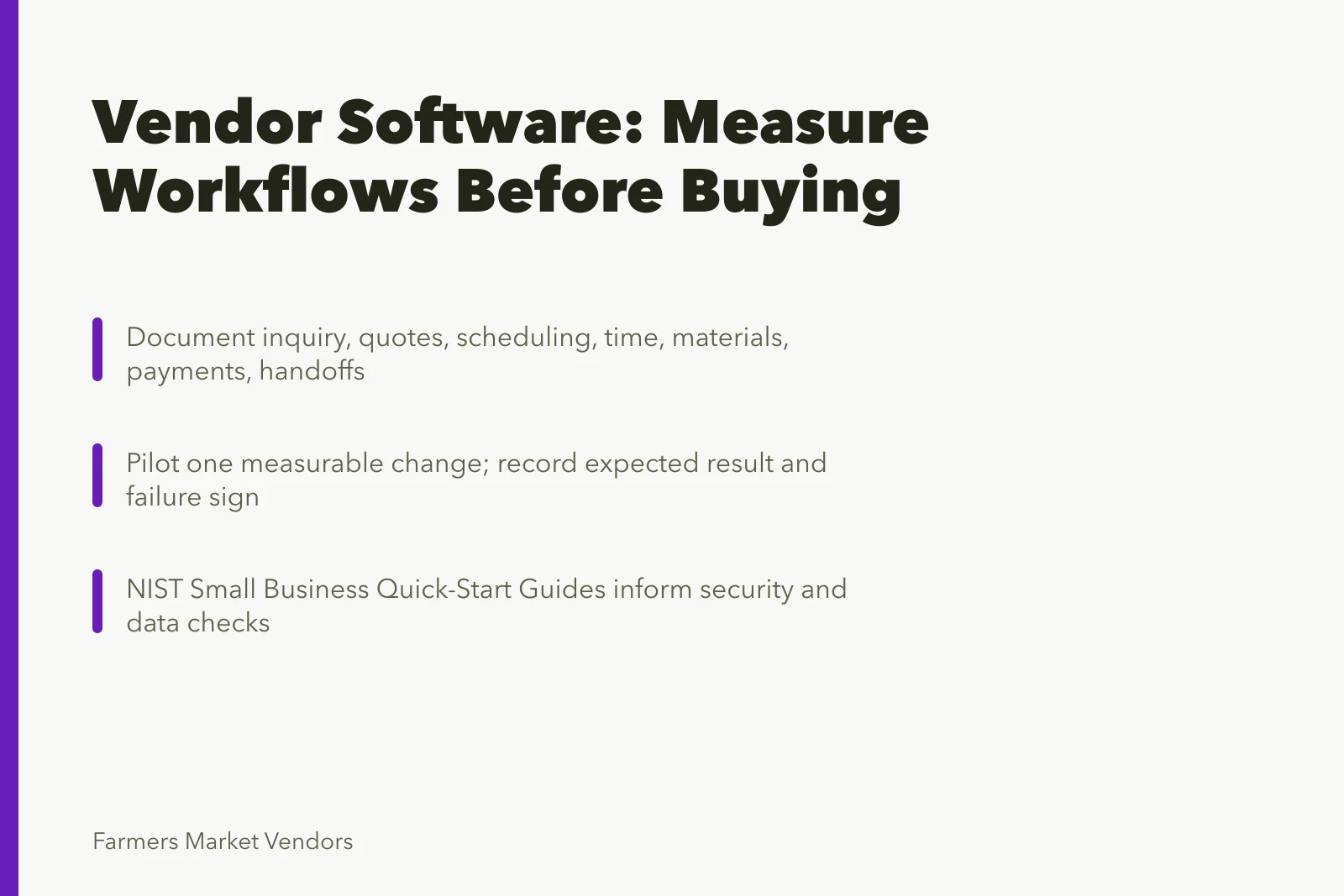
The NIST small business quick-start guides give small organizations a practical starting point for cybersecurity and privacy risk management. The CISA guidance for small and midsize businesses covers the common digital risks a one-tent operation actually faces.
Two habits cover most of it. Keep device lock screens on, and never store customer card data on a phone that travels in a tote bag.
A worked first month
- Week 1write down last Saturday's numbers. Units brought, units sold, booth fee, mileage, spoilage, cash in the drawer.
- Week 2calculate sell-through and margin by SKU for your five best sellers. Pick the one SKU to reprice or drop.
- Week 3call the market manager and your state cottage food office. Confirm fees, stall size, permit status and token handling in writing.
- Week 4run one software trial at a single market, then compare the export against your paper tally.
At the end of the month you have a break-even number, a repriced SKU, a confirmed permit position and one tested tool. That is a season's worth of decisions.
Worked first month
- Week 1Write down last Saturday's numbers
- Week 2Calculate sell-through and margin by SKU
- Week 3Confirm fees, stall, permits, tokens
- Week 4Run one software trial and compare export
Common questions
What should a farmers market vendor software system track first?
Start with sell-through rate, margin by SKU and break-even per market day. Those three connect the booth fee to what you actually sell. Features like loyalty programs and email marketing come after the basics work.
Do I need a commercial kitchen or can I use cottage food rules?
It depends on your product and your state. Cottage food statutes generally cover shelf-stable, non-hazardous goods and cap annual sales. Anything requiring refrigeration, or containing meat or dairy, usually needs a licensed commercial kitchen. Confirm with your state cottage food office and your local health department.
How do SNAP and WIC FMNP tokens settle?
Tokens are authorized, issued and redeemed on a schedule set by the market or the state agency, and reconciliation happens after the market day. Ask your market manager who authorizes vendors and what the redemption window is. Do not assume the token cash is yours until it settles.
What records should I keep for Schedule C?
Keep documents for purchases, sales, payroll, assets and other transactions, in a system that clearly shows income and expenses. Weekly cash-flow books make the year-end filing straightforward. A CPA can confirm what your situation requires.